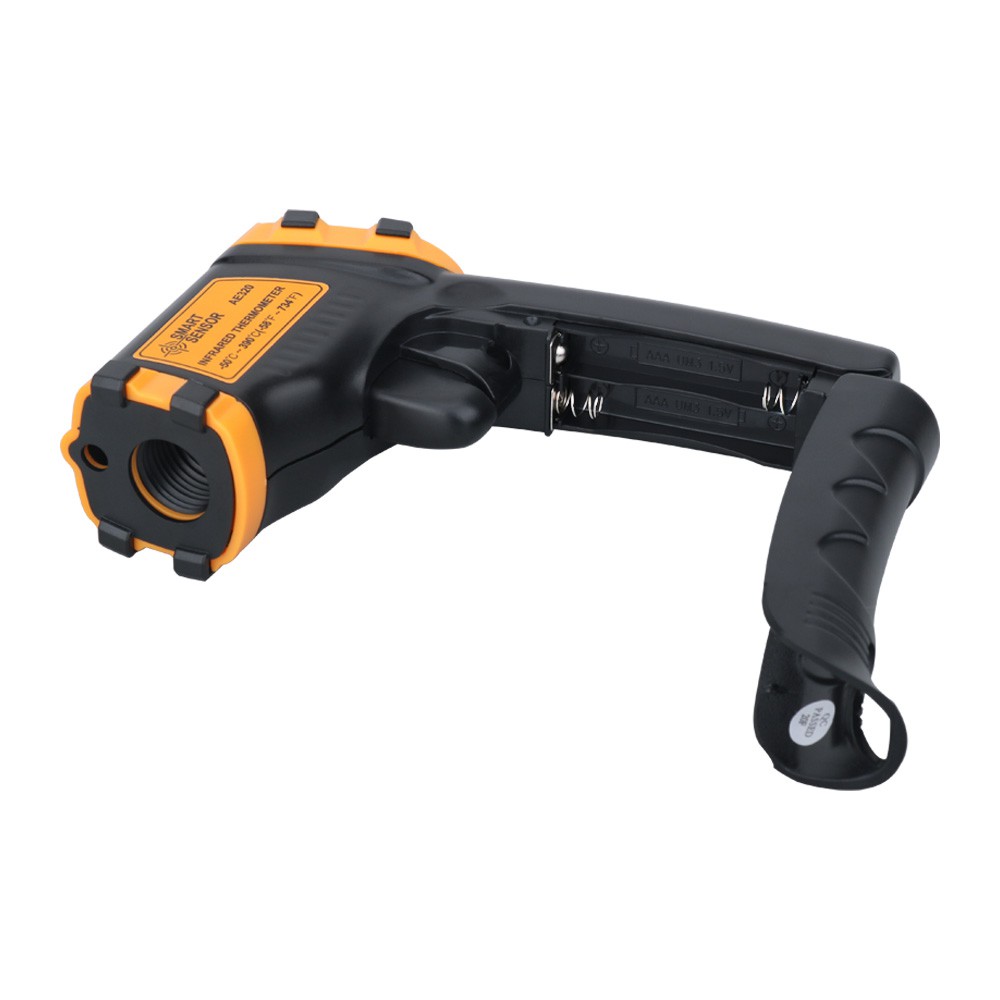
Measuring principle standard and development trend of infrared thermometer
There are many advantages to non-contact temperature measurement with an infrared thermometer, and its applications range from small or hard-to-reach objects to corrosive chemicals and sensitive surfaces. This article will discuss this advantage, give the decisiveness of the correct choice of infrared thermometer, etc. to illustrate the scope of application. Due to the movement of atoms and molecules, every object will radiate electromagnetic waves. The most important wavelength or spectral range for non-contact temperature measurement is 0.2 to 2.0 μm. Natural rays in this range are called thermal radiation or infrared rays.
A test instrument for temperature measurement by infrared rays radiated by a test object is called a radiation thermometer, a radiation thermometer or an infrared thermometer according to the German Industrial Standard DIN16160. These designations also apply to those instruments that measure temperature by visible colored radiation radiated by a body, and that derive temperature from relative spectral radiant densities.
Advantages of Infrared Thermometer Temperature Measurement
Non-contact temperature measurement by receiving infrared rays radiated from the object to be measured has many advantages. In this way, difficult-to-reach or moving objects can be measured without problems, such as materials with poor heat transfer properties or low heat capacity. The very short response time of the infrared thermometer enables fast and efficient regulation of the loop. Thermometers have no wearing parts, so there are no ongoing costs as there are with thermometers. Especially for small objects to be measured, such as contact measurement, there will be a large measurement error due to the thermal conductivity of the object. Here the thermometer can be used without any problems, and for aggressive chemicals or sensitive surfaces, such as on painted, paper and plastic rails. Through the long-distance remote control measurement, it can stay away from the dangerous area, so that the operator will not be in danger.
The principle structure of infrared thermometer
The infrared rays received from the measured object are focused on the detector through the lens through the filter. The detector generates a current or voltage signal proportional to the temperature through the integration of the radiation density of the measured object. In the electrical components connected thereafter, the temperature signal is linearized, the emissivity area is corrected, and converted into a standard output signal.
development trend
As in many sensing technology fields, the development trend of thermometers is also towards small, exquisite shapes, round shells with central threads are the most ideal shapes for installation on machines and equipment, and this development trend is Realization is through the continuous miniaturization of electrical components, and high calculus to make smaller and more delicate electrical components condensed in smaller and smaller spaces. Compared with the past analog technology, the precision of the linearization height of the detector signal is improved through the application of micro-controllers, thus also improving the accuracy of the instrument.
Market supply requires fast, inexpensive measurement value reception, which can directly output a temperature-proportional, linear current/voltage signal. Measurement value processing, such as leveling functions, special value storage, or boundary contacts will be placed in the intelligent On the display, regulator or SPS (program controller), the emissivity adjustment through the external cable can be adjusted outside the danger zone, even if the machine is running, and can also be adjusted by the SPS at this time. Through the use of body controls, the data bus interface can now be realized without any problems, but the network connection has not yet been realized, and the continued processing of the signal continues to use the standard analog signal of the past. In the detector section, a new material is used as a photoelectric sensor, which proves the improvement of sensitivity and even the improvement of resolution. In hot-film sensors, new sensors require only shorter adjustment times, the latest developments in pyrometers with collimators, are interchangeable lenses with zoom, can be replaced without calibration rechecks, use the same basis for different measurement positions Instruments save warehouse management costs.