Method for Locating Wire and Cable Breakpoints with a Multimeter
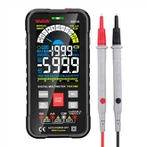
Besides measuring basic parameters such as voltage, current, resistance, capacitance and transistors, a digital multimeter can also be used in alternative ways to expand its functions and achieve multi‑purpose applications. Below is the method for locating breakpoints in wires and cables with a digital multimeter.
When an internal wire break occurs inside a cable, the exact position of the break is hard to identify due to the outer insulating sheath. A digital multimeter can easily solve this problem. The specific procedure is as follows: Connect one end of the broken wire (cable) to the 220 V AC live wire, and leave the other end unconnected. Set the digital multimeter to the AC 2 V range. Starting from the live‑wire connection end of the wire (cable), hold the tip of the black probe with one hand, and slide the red probe slowly along the outer insulation of the conductor. The reading on the display will be approximately 0.445 V (measured with a DT890D multimeter). When the red probe reaches a certain position, the displayed voltage drops abruptly to a few tenths of a volt (roughly one‑tenth of the original value). The breakpoint of the wire (cable) is located about 15 cm toward the live‑wire connection side from this spot.
This method does not work for shielded cables if only the inner core conductor is broken while the shielding layer remains intact.