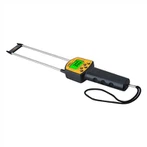
Methods of measurement and applications of wind gauges and thermal anemometers
Measurement of air flow speed instrument. It is more kinds, weather station * commonly used for the wind cup anemometer, it is made of three each other into 120 ° fixed in the bracket parabolic cone cups composed of induction part, the concave surface of the empty cups are to a direction. The whole induction part is mounted on a vertical rotating shaft, under the action of the wind, the wind cup rotates around the shaft at a speed proportional to the wind speed. Another type of rotating anemometer is the spinning-propeller anemometer, which consists of a three- or four-bladed propeller forming the sensing part, which is mounted in front of a wind vane so that it is always aligned with the direction of the incoming wind. The propeller rotates around a horizontal axis at a speed directly proportional to the wind speed. Commonly used types of anemometers are also: the use of the heat dissipation rate of the object being heated and the wind speed related principle made of ** anemometers; the use of acoustic wave transmission speed by the wind speed and thus increase and decrease the principle of ultrasonic anemometer.
Anemometer probe selection
0 to 100m/s flow velocity measurement range can be divided into three zones: low speed: 0 to 5m/s; medium speed: 5 to 40m/s; high speed: 40 to 100m/s. Anemometer's thermal probe is used for 0 to 5m/s **measurement; anemometer's rotating wheel probe to measure the flow velocity from 5 to 40m/s * ideal; and the use of the Pitot tube can be used to get the best results **in high speed range. ( Shanghai Yiou Instrumentation Equipment Co., Ltd. ) An additional criterion for the correct selection of anemometer flow velocity probe is the temperature, usually the thermal sensor of anemometer can be used up to a temperature of about +-70 C. The rotor probe of special anemometer can reach up to 350 C. The Pitot tube is used for more than +350C. Specific details are as follows:
Thermal probes for anemometers
The principle of operation of the thermal probe of anemometers is based on the fact that the cold impulse air flow carries away the heat from the thermal element, with the help of a regulating switch that keeps the temperature constant, then the regulating current is proportional to the flow rate. When using a thermal probe in turbulent flow, air currents from all directions simultaneously impinge on the thermal element, thus affecting the accuracy of the measurement results. When measuring in turbulence, the thermal anemometer flow rate sensor tends to show a higher value than the rotating wheel probe. The above phenomenon can be observed during duct measurements. Depending on the different designs used to manage duct turbulence, they can occur even at low speeds. Therefore, the anemometer measurement process should be carried out in a straight part of the duct. The starting point of the straight section shall be at least 10 x D (D = diameter of the pipe in CM) away in front of the measurement point; the end point shall be at least 4 x D behind the measurement point. The fluid section shall not be obstructed in any way. (corners, heavy overhangs, objects, etc.)