Multimeter - Current Measuring Skills and Principles
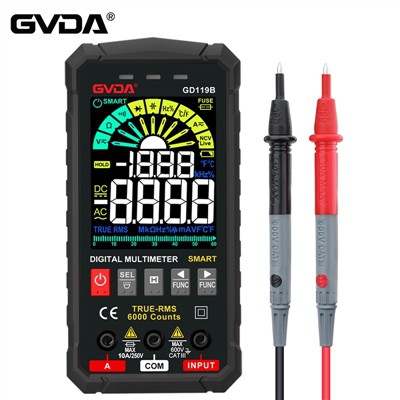
There are two ways to measure current with a digital multimeter. The first method is to directly use the digital multimeter for current measurement, which requires connecting the multimeter in series with the circuit under test, which means disconnecting the circuit and using the test leads of the digital multimeter to form a complete circuit. In this way, the entire circuit current flows through the circuit of the digital multimeter.
Another indirect method of measuring current with a DMM is to use a multimeter accessory known as a current probe. Clamps the probe around the conductor, eliminating the need to break the circuit and allowing measurement of high currents greater than 10A.
Digital multimeter measuring current principle
The basic principle of the multimeter is to use a sensitive magnetoelectric DC ammeter (microampere meter) as the meter head.
When a small current passes through the meter head, there will be a current indication. However, the meter head cannot pass a large current, so some resistors must be connected in parallel or in series on the meter head to shunt or lower the voltage, so as to measure the current, voltage and resistance in the circuit.
The measurement process of the digital multimeter converts the measured value into a DC voltage signal by the conversion circuit, and then converts the voltage analog quantity into a digital quantity by the analog/digital (A/D) converter, then counts through the electronic counter, and finally uses the digital measurement result displayed directly on the display.
How to measure current with digital multimeter
To avoid damage to the multimeter or the equipment under test:
Check the multimeter's fuses before measuring current.
When measuring, you must use the correct terminal, function file and range file.
Never connect the probes across (in parallel with) any circuit while the test leads are plugged into the current terminals. To directly measure current with a multimeter, you must disconnect the circuit under test, then connect the multimeter in series with the circuit, as follows:
1) With circuit power removed, all high voltage capacitors are discharged, creating a location where the probes of the multimeter can be inserted
2) Select A~ (AC) or A (DC) according to the needs and refer to the user manual of the product. Plug the black test probe into the COM input jack. Insert the red test probe into the ampere (A) or milliamp (mA/uA) input jack, depending on the expected reading.
3) If you use A terminal, please set the rotary switch to mA/A position. If you are using the mA/µA terminal, set the rotary switch to the µA position (for currents below 6000 µA (6 mA)) or the mA/A position (for currents above 6000 µA). Connect the probe tips across the disconnect so that the full current flows through the DMM (in series). (Touch the higher end of the disconnected circuit with the red probe and the lower end with the black probe. Reversing the polarity of the probes will produce a negative reading, but will not damage the multimeter.)
4) Reconnect the circuit power supply and read the displayed value;
5) Always pay attention to the units of measurement. Reconnect the circuit power supply and read the displayed value;
6) Always pay attention to the units of measurement. Turn off circuit power and discharge all high voltage capacitors. Remove the multimeter wiring and restore the circuit to normal operation.