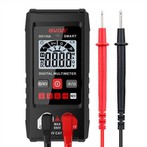
Multimeter measuring three-phase electricity all have voltage is how the matter
Test the phase that doesn't light up with an electric pen, from the power supply end to the test point location, poor contact at the switch or wire connector. Or the wire is disconnected.
When the two wires are twisted together, due to the oxidation over time, resulting in the formation of non-conductive oxide layer on the surface area of the wires, making the joints no longer conductive, resulting in an open circuit.
There is also a mistake in the aluminium wire and copper wire stranded together, copper and aluminium potential is different, copper and aluminium contact part will be accelerated due to the oxidation of the aluminium wire of the primary battery reaction, the copper and aluminium joints will be in poor contact after a long time.
When the joints form an oxide layer, no longer conductive after the wiring of the two ends of the wire before the existence of capacitance.
The wires twisted together with each other can be approximated as a whole flat piece put together by thin wires.
We can make a rough estimate based on what we learned about parallel plate capacitors in high school.
Parallel plate capacitor formula:
C=εs/d
A parallel plate capacitor is the simplest capacitor consisting of a layer of insulating material, a dielectric (air is also a dielectric), sandwiched between two parallel metal plates that are very close to each other.
s is the relative area of the wires at the two ends. If the radius r of the wires is 5 mm and the length l of the ends wrapped around each other is 10 cm.
The relative area s of the two ends of the wire is roughly,s = 2 × π × r × l = 2 × 3.14 × 0.005 × 0.1 = 0.00314 square.
d is the thickness of the oxide layer, assumed to be 100 µm.
In space, ε = 8.85 × 10⁻¹²F/m.
So it can be approximated to get C=270pF.