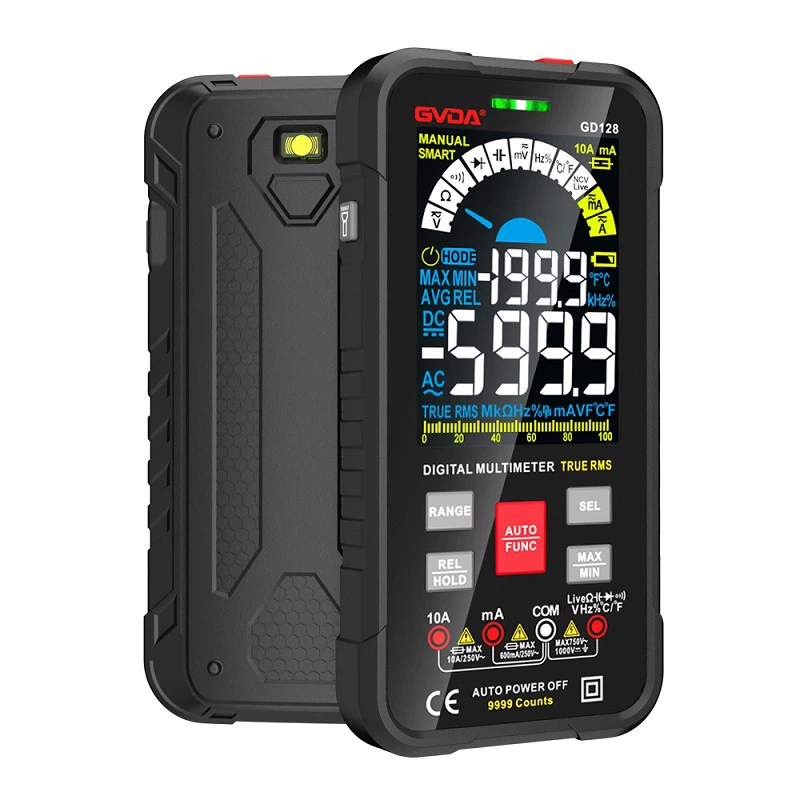
Multimeter selection and precautions
Selection of multimeter
1. The reading accuracy of pointer meters is poor, but the process of pointer oscillation is relatively intuitive, and the amplitude of its oscillation speed can sometimes objectively reflect the size of the measured object (such as the slight jitter of the TV data bus (SDL) when transmitting data); The reading on the digital meter is intuitive, but the process of numerical changes appears chaotic and difficult to observe.
2. There are usually two batteries inside a pointer meter, one with a low voltage of 1.5V and the other with a high voltage of 9V or 15V. The black probe is the positive terminal relative to the red probe. A 6V or 9V battery is commonly used for digital watches. In the resistance range, the output current of the pointer meter is much larger than that of the digital meter. Using the R × 1 Ω range can make the speaker make a loud "click" sound, and using the R × 10k Ω range can even light up the light-emitting diode (LED).
3. In the voltage range, the internal resistance of the pointer meter is relatively small compared to the digital meter, and the measurement accuracy is relatively poor. In some high-voltage microcurrent situations, it is even impossible to measure accurately because its internal resistance can affect the tested circuit (for example, when measuring the acceleration voltage of a TV cathode ray tube, the measured value may be much lower than the actual value). The internal resistance of the voltage range of a digital meter is very high, at least in the megaohm range, and has little impact on the tested circuit. However, the extremely high output impedance makes it susceptible to the influence of induced voltage, and the data measured in some situations with strong electromagnetic interference may be false.
4. In short, pointer meters are suitable for measuring analog circuits with relatively high current and high voltage, such as televisions and audio amplifiers. Digital meters are suitable for measuring low voltage and low current digital circuits, such as BP machines, mobile phones, etc. No, you can choose a pointer table or a number table according to the situation.
Precautions for multimeter
(1) Unless otherwise specified during the testing process, a pointer multimeter cannot be used to test computers and sensors. A high impedance digital multimeter should be used, and the internal resistance of the multimeter should not be less than 1OK Ω.
(2) Firstly, check the condition of fuses, fuses, and wiring terminals. After troubleshooting these areas, use a multimeter for inspection.
(3) When measuring voltage, the ignition switch should be turned on, and the battery voltage should not be lower than 11V.
(4) When checking waterproof connectors with a multimeter, be careful to remove the leather cover and do not apply excessive force to the terminals when inserting the test probe into the connector for inspection. During testing, the test probe can be inserted from the back end with wiring or from the front end without wiring.
(5) When measuring resistance, gently shake the wire in both vertical and horizontal directions to improve accuracy.
(6) When checking for a circuit break fault, the computer and corresponding sensor connectors should be disconnected first, and then the resistance between the corresponding terminals of the connector should be measured to determine whether there is a circuit break or poor contact fault.
(7) When checking for a short circuit fault in the grounding of the circuit, the connectors at both ends of the circuit should be disconnected, and then the resistance value between the tested terminal of the connector and the vehicle body (grounding) should be measured. A resistance value greater than 1M Ω indicates no fault.
(8) Before disassembling the electronic control system circuit of the engine, the power should be cut off first, that is, the ignition switch should be turned off (OFF), and the wiring on the battery pole should be removed.
(9) The symbol for the grounding terminal on the connector varies depending on the vehicle model, and attention should be paid to identifying it by referring to the maintenance manual.
(10) When measuring the voltage between two terminals or between two lines, the two probes of the multimeter (voltage range) should be in contact with the two terminals or wires being measured.
(11) When measuring the voltage of a terminal or a circuit, the positive probe of the multimeter should be in contact with the terminal or circuit being measured; And connect the negative probe of the multimeter to the ground wire.
(12) Checking the conductivity of terminals, contacts, or wires refers to checking whether the terminals, contacts, or wires are energized and not disconnected. The resistance value can be measured using a multimeter in the resistance range for inspection.
(13) When measuring resistance or voltage, the connector is generally disassembled, which divides the connector into two parts, one of which is called a sensor (or actuator) connector; The other part is called a sensor (or actuator) wire harness connector or a sensor (or actuator) connector (or connector sleeve) on one side of the wire harness. For example, after removing the connector on the fuel injector, one part is called the fuel injector connector, and the other part is called the fuel injector wiring harness connector or the fuel injector connector on one side of the wire. When measuring, it should be clear which part of the connector it is.
(14) All sensors, relays, and other devices are connected to the computer, which in turn is connected to the executing components through wires. Therefore, when checking for faults, testing can be conducted on the corresponding terminals of the computer connector.