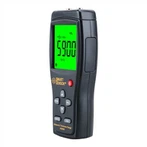
Ph meter composition and working principle
A pH sensor has a rod-like structure, usually made of glass, with a bulb at the bottom that houses the sensor. Glass electrodes used to measure pH have glass bulbs specially designed to be selective for hydrogen ion concentration. When immersed in the solution to be tested, the hydrogen ions in the test solution exchange with other positively charged ions on the glass bulb, creating an electrochemical potential on the bulb. An electronic amplifier detects the potential difference between the two electrodes generated in the measurement and converts the potential difference into pH units. According to the Nernst equation, the magnitude of the electrochemical potential across the glass bulb is linearly related to pH.
The reference electrode is insensitive to the pH of the solution and consists of a metal conductor connected to the display. The conductor is immersed in an electrolyte solution (usually potassium chloride) which is brought into contact with the test solution through a porous ceramic membrane. The display consists of a voltmeter that displays voltage in pH units.