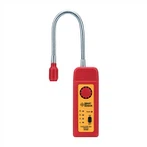
Phase sequence table wiring measurement method and phase missing problem
Regarding the wiring measurement method of the phase sequence table and the problem of phase loss, connect the three test lead wires of the phase sequence table to the three wires of the measured source respectively. The correct use of phase loss indication and phase sequence indication, etc., before opening the casing, Be sure to cut off the power supply.
1. Wiring
Connect the three test lead wires A (red, R), B (blue, S), and C (black, T) of the phase sequence table to the three wires A (R), B (S), and C (T) of the measured source respectively. on-line.
2. Measurement
Press the measurement button in the upper left corner of the meter, the light will turn on, and measurement will begin. When you release the measurement button, measurement stops.
3. Phase loss indication
The three red LEDs A, B, and C on the panel indicate the corresponding three-phase incoming calls respectively. When the measured source lacks phase, the corresponding luminous tube does not light up.
4. Phase sequence indication
When the three-phase phase sequence of the measured source is correct, the green light corresponding to the positive phase sequence lights up. When the three-phase phase sequence of the measured source is wrong, the red light corresponding to the reverse phase sequence lights up and the buzzer sounds an alarm.
Note 1: Positive phase sequence means UA0, UB0, UC0 (or UAB, UBC, UCA) lags 120 degrees in sequence; reverse phase sequence means UA0, UB0, UC0 (or UAB, UBC, UCA) leads 120 degrees in sequence.
Note 2: To change the reverse phase sequence into the positive phase sequence, just exchange any two of the three wires A, B, and C.
Note: When any one of the three-phase input lines is connected to power, the meter is live. Before opening the case, be sure to cut off the power supply.
1. Directly powered by the power source under test, no batteries required.
2. It has phase loss indication function: the three red LEDs A, B, and C on the panel indicate the corresponding three-phase incoming calls respectively. When the measured source lacks phase, the corresponding luminous tube does not light up.
3. Use sound and light as phase sequence indication: when the three-phase phase sequence of the source under test is correct, the green light corresponding to the positive phase sequence lights up; when the three-phase phase sequence of the source under test is wrong, the red light corresponding to the reverse phase sequence The light comes on and the buzzer sounds.