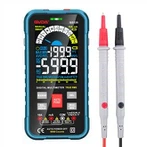
In order to avoid electric shock and personal injury, please read the "Safety Information" and "Warnings and Cautions" in the manual before use. The following specifications are general and general specifications:
a. Do not use if meter is damaged. Before using the meter, inspect the enclosure and especially the insulation next to the terminals.
b. Check the test leads for damaged insulation or exposed metal; check the continuity of the test leads; replace the damaged test leads before use.
c. Do not use the meter after abnormal use, its protection circuit may fail. When in doubt, please send the meter for repair.
d. Do not use the meter in an explosive gas, water vapor or dusty environment.
e. Do not input the rated voltage marked on the meter on the meter terminals (two input terminals, or any input terminal and earth).
f. Before use, use the meter to measure a known voltage to confirm that the meter is normal.
g. When measuring current, turn off power to the circuit before connecting the meter to the circuit.
h. When servicing the meter, use only the parts marked or supplied by the manufacturer.
i. The meter must be used according to the method specified in this manual, otherwise the protection provided by the meter may be invalid.
j. Please pay special attention when measuring AC voltage with an effective value of 30V, AC voltage with a peak value of 42V, or DC voltage above 60V, because such voltages may cause the danger of electric shock.
k. Keep your finger behind the bezel of the test lead.
l. When measuring, before connecting the red test lead wire, you should connect the black test lead wire (common end); similarly, when disconnecting, you should first disconnect the red test lead wire and then disconnect the black test lead wire.
m. When opening the battery door, please remove the test leads from the meter first.
n. Do not use the meter when the cover of the meter is open or loose.
Low battery power o. To avoid the risk of electric shock or personal injury caused by wrong readings, please replace the battery immediately when the meter indicates low voltage ( ).
p. Do not measure Class II voltages above 600V or other higher classes.
q. Overvoltage device category per IEC61010-1, 2000: The meter is designed to protect against transient high voltages occurring in equipment of the following categories:
CAT I High voltage low energy circuits such as electronic circuits or copiers
CAT II Equipment powered by fixed installations, such as televisions, personal computers, portable tools and household appliances.
CAT III Fixed installation equipment, such as distribution panels, feeders and short circuit protection circuits, lighting systems in large buildings.