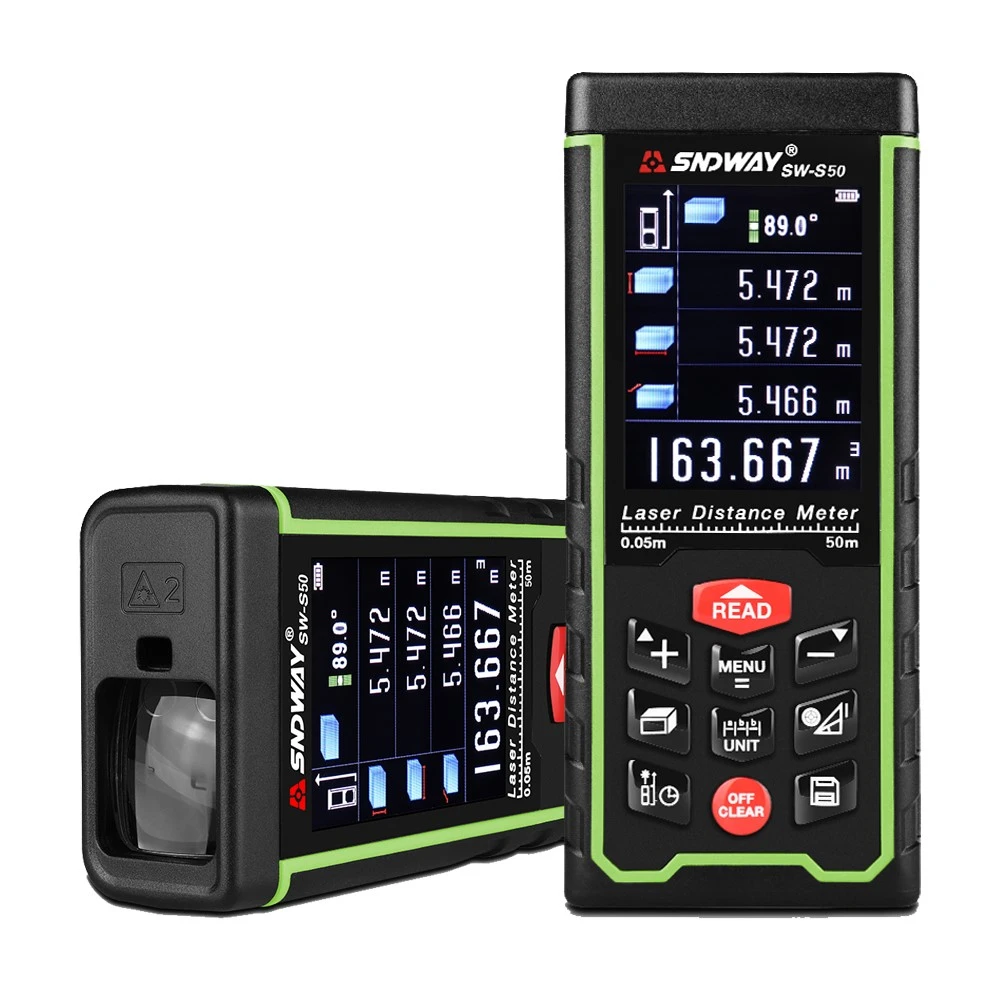
Principle Analysis of Temperature and Humidity Monitoring and Rangefinders
Laser rangefinders generally adopt two methods for distance measurement: the pulse method and the phase method. The process of pulse ranging is as follows: the laser emitted by the rangefinder is reflected by the measured object and then received by the rangefinder. The rangefinder records the round-trip time of the laser at the same time. Half of the product of the speed of light and the round-trip time equals the distance between the rangefinder and the measured object. The measurement accuracy of the pulse method is generally about ±1 meter. In addition, the blind zone of this type of rangefinder is generally around 15 meters.
Laser ranging is one type of optical ranging. If light travels back and forth between points A and B in the air at speed c, and the time required for one round trip is t, then the distance D between points A and B can be expressed as:
\(D=ct/2\)
Where: D - the distance between measurement points A and B; c - the speed of light propagating in the atmosphere; t - the time required for light to travel one round trip between A and B.
It can be seen from the above formula that measuring the distance between A and B essentially requires measuring the light propagation time t. According to different time measurement methods, laser rangefinders are usually divided into two measurement types: pulse type and phase type.