Selection and Measuring Principle of Laser Rangefinders
With the development of science and technology, many people are still unfamiliar with laser rangefinders. Some workers still use tape measures to measure distances and manually calculate areas and volumes. Below is an introduction to the principle and operation method of laser rangefinders to help workers work and study with higher efficiency and precision.
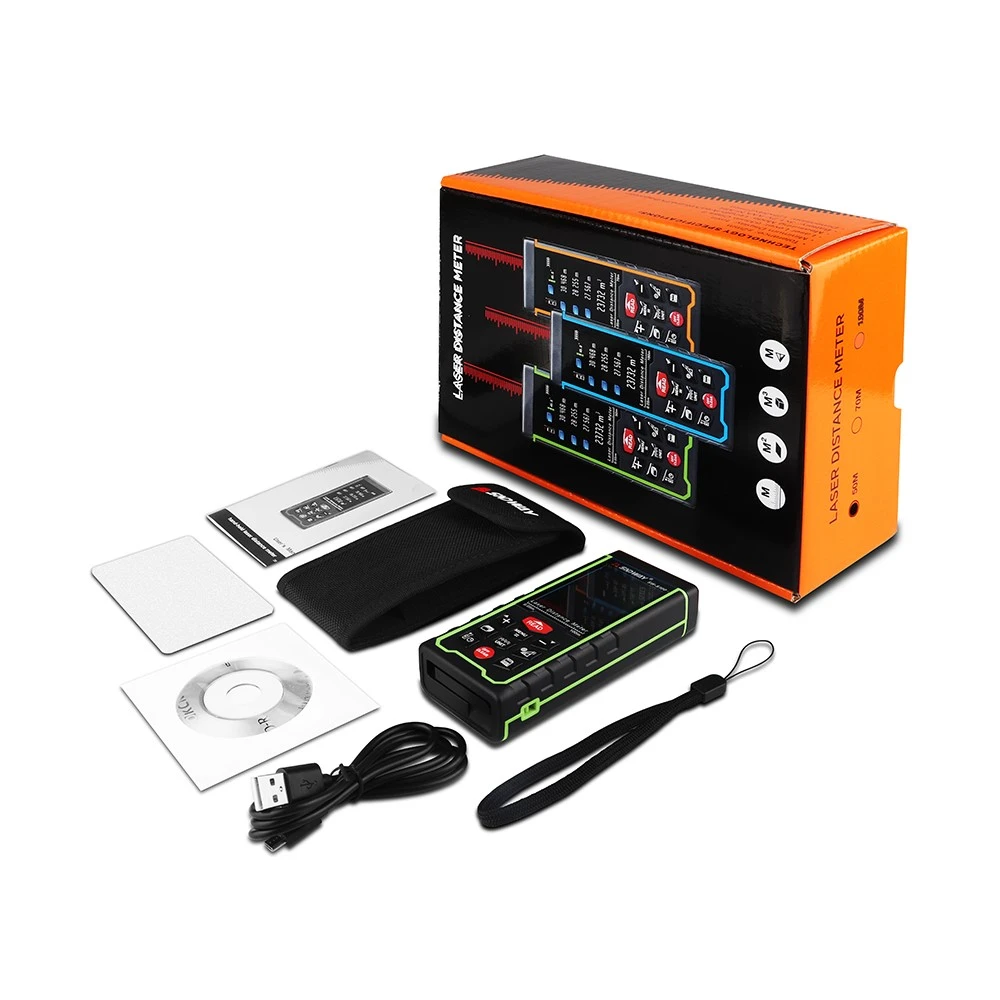
A laser rangefinder is an instrument that accurately measures the distance to a target using laser light. During operation, the laser rangefinder emits a thin laser beam toward the target. A photoelectric component receives the laser beam reflected from the target, and a timer measures the time taken for the laser beam to travel from emission to reception, calculating the distance from the observer to the target. If the laser is emitted continuously, the measuring range can reach approximately 40 kilometers, supporting day and night operation. Pulsed laser emission generally offers lower absolute accuracy, yet delivers excellent relative accuracy for long-distance measurement.
The world's first laser was developed in 1960 by scientist Maiman at Hughes Aircraft Company in the United States. The US military quickly launched research on laser devices based on this breakthrough. In 1961, the first laser rangefinder passed US military demonstration tests, after which laser rangefinders rapidly entered practical application.
Laser rangefinders are lightweight, compact, simple to operate, fast and accurate. Their measurement error is only 1/5 to 1/100 of that of other optical rangefinders. Therefore, they are widely used in topographic surveying, battlefield measurement, ranging for targets of tanks, aircraft, warships and artillery, as well as measuring the altitude of cloud layers, aircraft, missiles and artificial satellites. They serve as vital technical equipment to improve the firing accuracy of tanks, aircraft, warships and artillery.
As the price of laser rangefinders continues to decline, they have gradually been adopted in industrial applications. A new generation of miniature rangefinders with fast measurement, small size and reliable performance has emerged at home and abroad. These devices can be widely applied in industrial measurement and control, mining, ports and other fields.