Principle of infrared thermometer
1. Overview of infrared thermometers
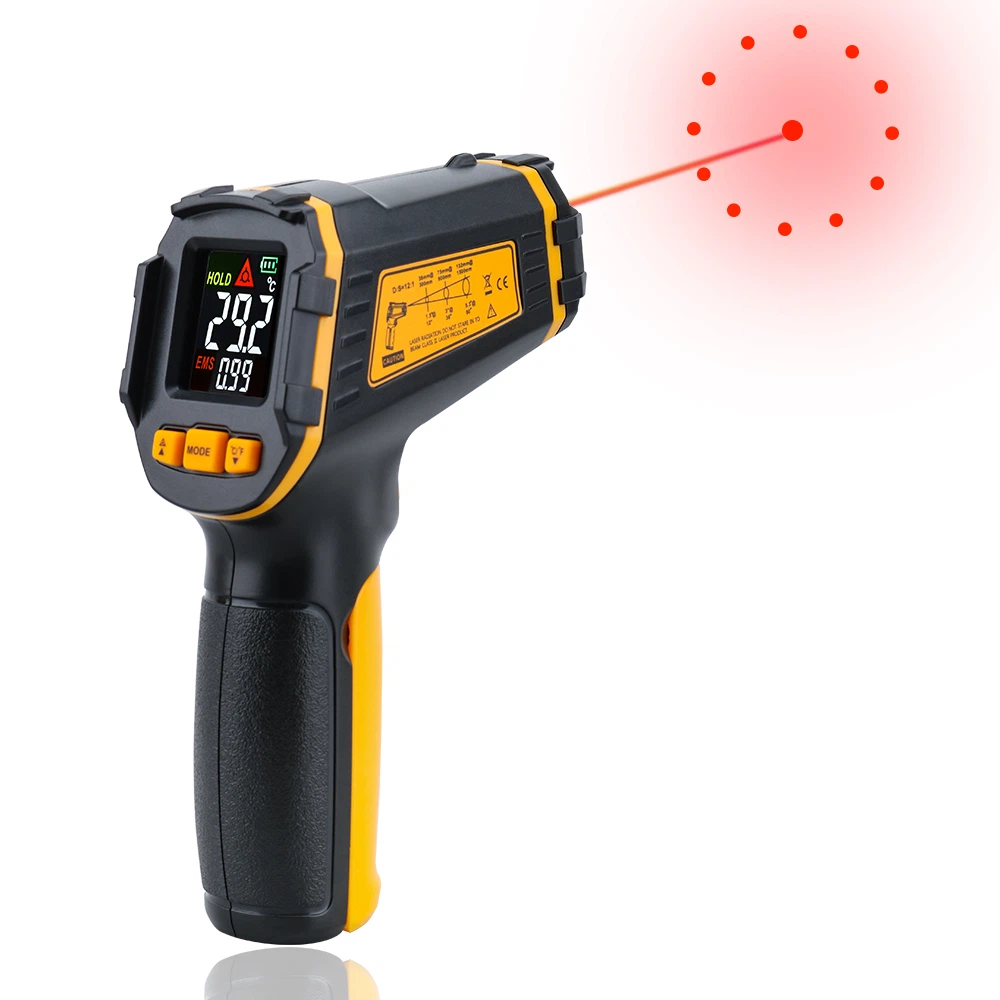
In the production process, infrared temperature measurement technology plays an important role in product quality control and monitoring, equipment online fault diagnosis and safety protection, energy saving and emission reduction. In the past 20 years, the non-contact infrared thermometer technology has developed rapidly, the performance has been continuously improved, the function has been continuously enhanced, the variety has continued to increase, and the application scope has continued to expand, and the number of products has increased year by year. Compared with the contact temperature measurement method, the infrared thermometer has the advantages of fast response time, non-contact, safe use, and long service life. Non-contact infrared thermometers include portable, online and scanning three series, and are equipped with a variety of options and computer software. Within each series, there are various models and specifications. Among the many thermometers of different specifications, it is very important for users to choose the correct model of external thermometer.
Infrared detection technology is a key promotion project of national scientific and technological achievements in the "Ninth Five-Year Plan". Infrared detection is a high-tech detection technology that does not require power-off online monitoring. It integrates photoelectric imaging technology, computer technology and image processing technology. It receives the infrared radiation emitted by the object and displays its thermal image on the fluorescent screen, so as to accurately judge the temperature distribution on the surface of the object. It has the following advantages: accuracy, real-time performance and rapidity. Any object continuously radiates infrared heat energy due to the movement of its own molecules, thus forming a certain temperature field on the surface of the object, commonly known as "thermal image". Infrared diagnostic technology measures the temperature and temperature field distribution on the surface of the device by absorbing this infrared radiation energy, thereby judging the heating condition of the device. At present, there are many test equipments using infrared diagnostic technology, such as infrared thermometers, infrared thermal TVs, and infrared thermal imaging cameras. Infrared thermal imaging TV, infrared thermal imaging camera and other equipment use thermal imaging technology to convert this invisible "thermal image" into a visible light image, which makes the test effect intuitive and high sensitivity, and can detect subtle changes in the thermal state of the equipment and accurately reflect it. The heating conditions inside and outside the equipment are highly reliable, which is very effective in detecting hidden dangers of the equipment.
Infrared diagnostic technology makes reliable predictions of early fault defects and insulation performance of electrical equipment, making preventive testing and maintenance of traditional electrical equipment a standard business development direction introduced by the former Soviet Union in the 1950s. In particular, the development of large-scale units and ultra-high voltages has put forward higher and higher requirements for the reliable operation of the power system, which is related to the stability of the power grid. With the continuous development of modern science and technology, after maturity and daily improvement, infrared state monitoring and diagnosis technology is adopted, which has the characteristics of long-distance, non-contact, non-sampling, non-disintegration, accurate, fast and intuitive, and conducts real-time online monitoring of electrical equipment. Monitoring and diagnosing most faults can cover almost all kinds of fault detection of electrical equipment. It has attracted extensive attention from the electric power industry at home and abroad. It was the most advanced maintenance system commonly used in the late 1970s and has grown rapidly. The application of infrared detection technology is of great significance to improve the reliability and effectiveness of electrical equipment, improve operational economic benefits, and reduce maintenance costs. It is a good method that is widely promoted in the field of predictive maintenance today, which can improve the maintenance level and the health of equipment to a higher level.
Using infrared imaging detection technology, non-contact detection of equipment in operation can be performed, its temperature field distribution can be photographed, the temperature value of any part can be measured, and various external and internal faults can be diagnosed accordingly. Real-time, remote measurement, with quantitative measurement It is very convenient and effective for the detection of operating equipment and live equipment in power plants, substations, and transmission lines.
The method of using a thermal imager to detect online electrical equipment is infrared thermography. Infrared thermal imager is a new technology used in industry for non-destructive testing, testing equipment performance and grasping its operating status. Compared with traditional temperature measurement methods such as thermocouples and wax slices with different melting points, the thermal imager can detect the temperature of the hot spot within a certain distance in real time, quantitatively and accurately. online. It can draw the temperature gradient thermal image of the equipment in operation, with high sensitivity, free from electromagnetic field interference, and convenient for on-site use. It can detect thermally induced faults in electrical equipment over a wide range of -20°C to 2000°C with a high resolution of 0.05°C, revealing heat generated by wire splice or clips and localized hot spots in electrical equipment.
Infrared diagnostic technology of charged equipment is a new discipline. It is a comprehensive technology that utilizes the thermal effect of charged equipment and uses special equipment to obtain infrared radiation information from the surface of the equipment, and then judges the condition of the equipment and the nature of defects.
2. The basic principle of infrared thermometer
In 1672, it was discovered that sunlight (white light) is composed of light of various colors. At the same time, Newton made monochromatic light, which was inherently simpler than white light. famous conclusion. Using a dichroic prism, the sunlight (white light) is decomposed into monochromatic light of red, orange, yellow, green, cyan, blue, purple and other colors. In 1800, British physicist FW Huxel discovered infrared light when Huxel was studying various colors from a thermal point of view. When he was studying the heat of various colors, he deliberately blocked the window of the dark room with a blackboard, and cut a rectangular hole in the blackboard with a dichroic prism. When sunlight passes through the prism, it is broken down into colored bands of light, and a thermometer is used to measure the heat contained in the different colors in the bands. To compare with the ambient temperature, Huxel used several thermometers placed near the colored light strips as comparison thermometers to measure the ambient temperature. During the experiment, he stumbled upon a strange phenomenon: the thermometer placed outside the red light was rated for a higher temperature than the rest of the room. After trial and error, this so-called high temperature area with the most heat is always outside the red light at the edge of the strip. So he announced that in addition to the visible radiation emitted by the sun, there is also a "hotline" invisible to the human eye. This invisible "hot ray" lies outside the red light and is called infrared light. Infrared is an electromagnetic wave that has the same nature as radio waves and visible light. The discovery of infrared rays is a leap in human understanding of nature, which opens up a new and broad road for the research, utilization and development of infrared technology.