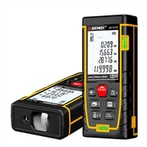
Principle of laser ranging telescope.
Laser ranging telescopes usually use the pulse method to measure distances. The pulse ranging process is as follows: the laser emitted by the rangefinder is received by the rangefinder through the reflection of the measuring object, and the laser round-trip time is recorded. Half the speed of light and the round-trip time is the distance between the rangefinder images.

Ordinary laser rangefinders are generally used in fields with low precision requirements, such as outdoor sports and ballistic calculations.
High-precision laser rangefinders are generally used in high-demand fields such as construction, land surveying, power monitoring, and engineering surveying. At present, high-end products such as Tupas can reach 0.3 meters.
In addition, because the laser rangefinder needs to ensure the collimation of the optical system and the laser system within a wide measurement range, there is usually a measurement blind spot. At present, the blind area of a good ranging telescope can reach 3.5 meters, and the general ranging telescope ranges from 10 meters to 15 meters.