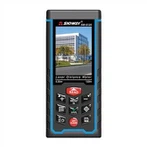
Principles and applications of phase laser rangefinder
The phase laser rangefinder uses the laser beam to modulate the amplitude and measure the phase delay caused by the modulation light going back and forth to the measuring line once, and then converts the distance represented by this phase delay according to the wavelength of the modulation light. That is, the time required for light to pass through the round-trip measuring line is measured by indirect method.
Phase laser rangefinder is generally used in precision ranging. Because of its high accuracy, which is generally millimeter level, in order to effectively reflect the signal and limit the measurement target to a specific point commensurate with the accuracy of the instrument, this kind of rangefinder is equipped with a mirror called cooperative target.
If the angular frequency of the modulated light is ω, and the phase delay generated by a round trip on the distance d to be measured is φ, then the corresponding time t can be expressed as:
t=φ/ω
Substituting this relationship into equation (3-6), the distance d can be expressed as
D=1/2 ct=1/2 c·φ/ω=c/(4πf) (Nπ+Δφ)
=c/4f (N+ΔN)=U(N+)
Where:
Φ —— The total phase delay caused by the signal going back and forth from the measuring line at one time.
Ω-the angular frequency of the modulation signal, Ω = 2π f.
U-unit length, the value is equal to 1/4 modulation wavelength.
N—— The number of modulation half-wavelength included in the measuring line.
Δ φ —— The part where the phase delay is less than π when the signal travels to and from the measuring line at one time.
ΔN—— The fractional part of the modulation wave contained in the measuring line is less than half a wavelength.
ΔN=φ/ω
Under the given modulation and standard atmospheric conditions, the frequency c/(4πf) is a constant, at this time, the distance measurement becomes the measurement of the number of half-wavelength contained in the survey line and the measurement of the fractional part less than half-wavelength, that is, the measurement of N or φ. Due to the development of modern precision machining technology and radio phase measurement technology, the measurement of φ has reached a high accuracy.
In order to measure the phase angle φ less than π, different methods can be used to measure it. Usually, delayed phase measurement and digital phase measurement are the most widely used, and short-range laser rangefinders all use digital phase measurement principle to obtain φ.
Generally speaking, the phase laser rangefinder uses continuous emission of laser beam with modulation signal, and in order to obtain high ranging accuracy, it needs to be equipped with cooperative targets. The hand-held laser rangefinder is another new rangefinder in the pulse laser rangefinder, which is not only small in size and light in weight, but also adopts digital phase-measuring pulse broadening subdivision technology, which can achieve millimeter-level accuracy without cooperative targets, and the measuring range has exceeded 100m, and can directly display the distance quickly and accurately. It is the latest length measurement standard instrument in short-range precision engineering survey and building construction area survey. Now the most widely used is the DISTO series hand-held laser rangefinder produced by leica.