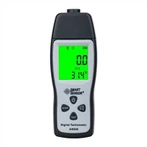
Principles and safety measures for using poisonous and hazardous gas detectors
Recently, gas detectors, an indispensable equipment in life, are not only expanding with the development of economy, but also the environmental hazards are expanding. If we want to live a better life, we need to protect our personal life through gas detectors. Safety. However. What technologies are used for toxic and harmful gas detectors?
First of all, it is necessary to know that the toxic gas detector is an instrumentation tool for detecting the concentration of toxic gas leakage, mainly referring to portable/handheld gas detectors. Toxic gas sensors are mainly used to detect the types of gases present in the environment. Toxic gas detectors are not universal like flammable gas detectors. Toxic gas detectors are a kind of gas detectors with strong pertinence, and are selected according to the specific toxic gases to be measured. For example: carbon monoxide detector and CL2 gas detector, although they are both called toxic gas detectors, but because the specific gases they measure are different, they are completely different toxic gas detectors. If you take a carbon monoxide detector to When detecting CL2 gas in the presence of HCL gas, the carbon monoxide detector will not respond.
That is to say, carbon monoxide detectors cannot detect CL2 gas, so before selecting a toxic gas detector, it must be clear what kind of toxic gas to measure. Toxic gas detectors choose pump suction type or diffusion type according to their toxicity. If the poisonous gas is very toxic, it will be dangerous for people to enter. In this case, a pump poisonous gas detector must be selected. If the poisonous gas is not very toxic, it is allowed to exist in a small amount, but long-term inhalation will also cause danger. Yes, in this case, you can choose a diffusion toxic gas detector, such as a place where carbon monoxide exists.
Generally, we need to master a few points for the precautions of toxic and harmful gas detectors:
1. Pay attention to regular calibration and testing:
Toxic and harmful gas detectors are the same as other analytical and testing instruments, which are measured by relative comparison method: first, the instrument is calibrated with a zero gas and a gas with a standard concentration, and the standard curve is obtained and stored in the instrument. During the measurement, the instrument compares the electrical signal generated by the gas concentration to be measured with the electrical signal of the standard concentration, and calculates an accurate gas concentration value. Therefore, zeroing the instrument at any time and frequently calibrating the instrument are essential tasks to ensure the accuracy of the instrument measurement. It should be noted that many gas detectors can replace the detection sensor at present, but this does not mean that a detector can be equipped with different detector probes at any time. Whenever the probe is changed, the instrument must be recalibrated in addition to the sensor activation time. In addition, it is recommended to test the response of the standard gas used for the instrument before using it to ensure that the instrument really plays a protective role.
2. Pay attention to the concentration measurement range of the detection instrument: all kinds of toxic and harmful gas detectors have their fixed detection range. Only when the measurement is completed within its measurement range can it be guaranteed. Verify that the instrument is measuring accurately. However, measuring beyond the measurement range for a long time may cause permanent damage to the sensor. For example, if the LEL detector is accidentally used in an environment exceeding 100% LEL, the sensor may be completely burned. As for the toxic gas detector, it will also cause damage if it is used at a higher concentration for a long time. Therefore, if the fixed instrument sends an over-limit signal during use, the measurement circuit should be turned off immediately to ensure the safety of the sensor.