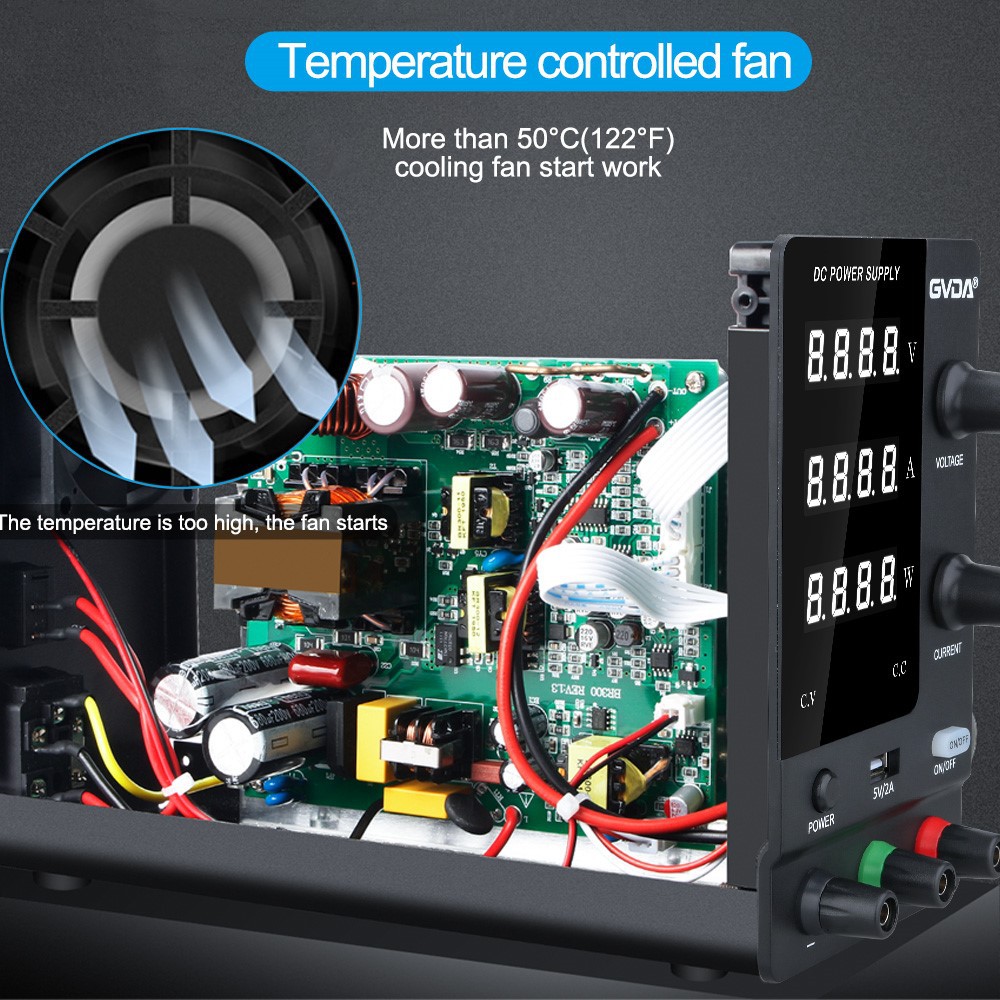
Problems and solutions encountered in actual maintenance of inverter switching power supply:
1. Delta frequency converter (fault phenomenon: no display when powered on)
After testing, it was found that the main circuit of the power supply, charging resistor, and main circuit contactor were all normal, therefore it was determined that there was a fault with the switch power board. Measure the switch power board according to the above repair steps. During the first step of measurement, it was found that the 330K Ω/2W step-down resistor between the DC bus 560V and the PWM modulation chip was damaged. The nominal 330K Ω/2W resistor had an actual measured value of over 2M Ω, so the PWM modulation chip could not receive power to start and could not operate. For the sake of caution, key components such as switch tubes, transformers, rectifier diodes, and filtering capacitors were also tested. After confirming that there were no problems, they were powered on and tested. OK! The switch power supply started to vibrate, and the output voltage of each group was normal. After reinstalling the frequency converter, the power test was normal. This frequency converter has been repaired. (Note: Maintenance personnel must develop a habit during maintenance: do not rush to replace the faulty components after discovering them. Be sure to test all high-power and easily damaged components, and try again after confirming that there are no problems. This is both safe and secure.).
2. Tai'an frequency converter (fault phenomenon: no display when powered on)
After testing, it was found that the main power circuit, charging resistor, and main circuit contactor are all normal, and the fault was determined to be on the power board. Measure the switch power board according to the maintenance steps.
The first step of measurement passed, and during the second step of measurement, it was found that the C-E junction of the switch tube was broken down. It was removed and key components such as the transformer, rectifier diode, and filter capacitor were tested. After confirming that there were no problems, they were powered on for testing. The output voltage of each group was normal, and the installation test was normal. The fault was eliminated.
3. Siemens frequency converter (fault phenomenon: no display when powered on)
After testing, it was found that the main power circuit, charging resistor, and main circuit contactor are all normal, and the fault was determined to be on the power board. Measure the switch power board according to the maintenance steps.
The first step measurement passed, the second step measurement passed, the third step measurement passed, and the fourth step measurement passed. Then, separately power on the power board and measure that the power terminal of the PWM modulation chip has a voltage of about 12.5V to ground, indicating that the power supply is normal. Using an oscilloscope to observe the PWM output terminal of the chip, it was found that there was no PWM modulation waveform. After replacing the PWM modulation chip, the power on test was normal and the fault was resolved.
4. Schneider inverter (fault phenomenon: no display when powered on)
After testing, it was found that the power supply main circuit, charging resistor, and main circuit contactor were all normal, and the fault was determined to be on the power board. Measure the switch power board according to the maintenance steps.
The first step measurement passed, the second step measurement found that the switch tube was broken down, the third step measurement passed, and the fourth step measurement passed. After replacing the switch tube with a new one and separately powering on the power board, the tube burned again. After removing the switch tube without installing the tube, conduct a power on test and measure that the power terminal of the PWM modulation chip has a voltage of about 12V to ground, which is also normal. Using an oscilloscope to observe the PWM output terminal of the chip, it was found that the PWM wave was only about 5-6 KHZ. After cutting off the power, the timing component was removed and measured. It was found that the resistance of the timing resistor had increased. After replacing the timing resistor and switch tube, the power supply tube was powered on normally and no longer burned. The fault was resolved.