Requirements for the Color of the Microscope Illumination Source When Observing Fine Details
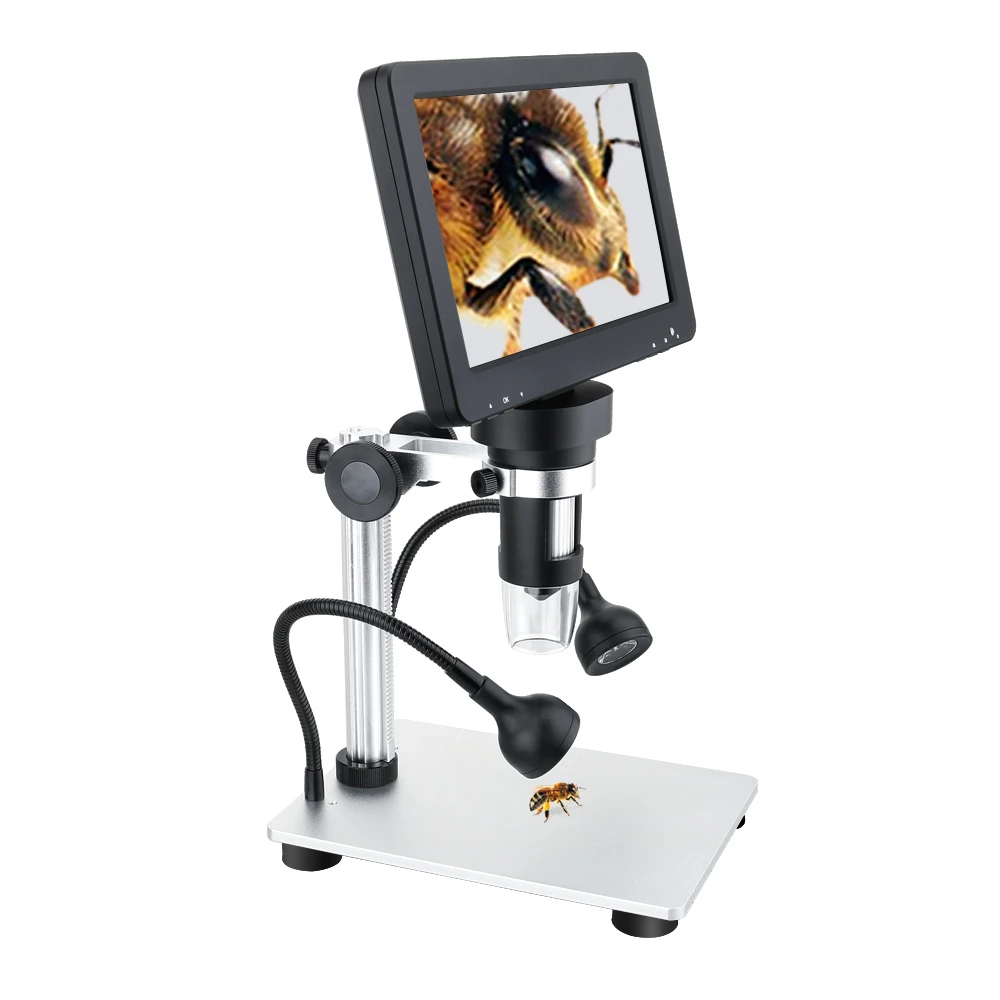
When observing fine details of an object, a relatively high-magnification setting is generally used, which requires a light source with relatively high brightness. In terms of color: if the color of the observed area is close to that of its surroundings, it is best that the color of the light source is similar or identical to the color of the observed area for clearer viewing. If the observed area differs in color from its surroundings, select a light source whose color is as close or identical to that of the observed area as possible.
A general rule can be summarized: for an object of a certain color, a light source of similar or identical color is preferred.
Horizontal Observation with a Microscope
In the electronics industry, inspection is required to check whether the pins on circuit boards are aligned and whether solder joints are flat. This calls for an instrument capable of horizontal observation. Our solution for this application uses a horizontal support stand for monocular microscopes to place the monocular microscope horizontally for horizontal viewing. The stand features a vertical adjustment travel of 55 mm
for the main unit, plus an XY stage with a travel range of 72 × 30.5 mm. The base dimension is 387 × 267 × 27 mm.
LED Illumination and Arrangement
LED illumination supports flexible arrangement layouts to achieve high-density light output. Light is highly concentrated at the central region of the illumination source, delivering sharp, vivid images. This type of light source has a fast response time and can reach full brightness within 10 microseconds or less. It features ultra-low power consumption, accepts wide-range input voltages to adapt to different power supplies, and has a long service life.
Significance of Zoned Multi-angle LED Illumination
When applied to microscopic observation, zoned multi-angle LED illumination enables viewing of the specimen from multiple angles using a single light source. For example, during three-dimensional observation, multiple side surfaces of electronic components need to be inspected by rotating the observation head. A coaxial light source fails to clearly reveal side surfaces, especially recessed side features with poor imaging results. If an external cold light source is adopted, frequent adjustment of the light angle is required, which is cumbersome to operate. In such scenarios, zoned multi-angle LED illumination is ideal.