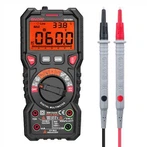
Service Environment and Primary Functions of Gas Detectors
Gas detectors can generally be used in a variety of environments. Operation within suitable environments ensures stable equipment performance and rational maintenance cycles. They are widely applied in petrochemical industry, industrial production, mineral exploitation, flue gas and exhaust environmental monitoring, sewage treatment, biopharmaceuticals, household environmental protection, school laboratories and other fields.
Gas detectors are commonly used for leak inspection in gas storage areas. They are particularly suitable for use around process equipment, pipeline systems and before entry into confined spaces. Designed for one-hand operation, the instrument is equipped with a built-in pump and a flexible sampling probe to locate leakage sources precisely. Its large-character display with backlight allows clear reading of measured gas concentrations in dim or dark conditions.
Users shall be familiar with parameters and relevant specifications of their gas detectors to guarantee accurate readings and avoid instrument damage.
The sensor serves as the core component of a gas detector. In short, the classification of gas detectors corresponds to the types of their sensors. This article introduces the detection principles and applications of gas detectors.
A gas detector is essential safety equipment that detects toxic and harmful gases via its built-in system and triggers early warnings. Its common detection technologies and categories are as follows:
① Electrochemical Sensors The electrochemical sensor is a common and mature technology currently adopted in gas detectors for toxic and harmful gas measurement. It features compact size, low power consumption, favorable linearity and repeatability, as well as relatively long service life.
② Colorimetric Tube Measurement Technology Apart from toxic gas alarms, colorimetric tube technology remains a detection method for toxic and harmful gases used in industrial environmental protection. Based on chemical color reaction, this method can make up for the deficiency when no appropriate sensor is available for instrumental measurement.
③ Ionization Detectors Commercially available ionization detectors include Photoionization Detectors (PID) and Flame Ionization Detectors (FID), which are widely used toxic gas detectors for gas chromatographs. Instruments equipped with these two types of sensors have become common solutions for detecting volatile organic compounds.
④ Semiconductor Sensors The sensing element of a semiconductor gas detector is made of metal oxide or metal semiconductor oxide materials. When interacting with gas, surface adsorption or chemical reaction occurs, leading to changes in conductivity, volt-ampere characteristics or surface potential characterized by carrier movement. This type of sensor can detect combustible gases at percentage concentrations as well as toxic gases at the ppm level.
For gas detectors, it is necessary to master not only operating methods, but also applicable environments and working principles. Comprehensive understanding of gas detectors enables users to make adequate preparations before operation.