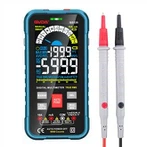
Seven ways to resist interference with multimeter instruments
During the use of instruments and meters, how to perform anti-interference operations is a major issue that needs to be considered. Here is a summary of seven methods of anti-interference for instruments and meters, including anti-interference processing from the aspects of static voltage interference and pulse interference.
1. Electrostatic induction (referring to electrical coupling)
Electrostatic induction is the result of the interaction between two electric fields. Among two opposite wires, if the potential of one changes, the potential of the other wire will also change due to the change in capacitance between the wires. The interference source is capacitively coupled in the loop. causing interference.
2. Pulse interference
Some pulse-like interference voltages can act on analog circuits and directly enter digital circuits to cause interference. The sources of these interference voltages are inductive loads such as switches, motors, relays, and machines that generate discharges.
3. Additional thermoelectric potential and chemical potential
The thermoelectric potential generated by different metals and the chemical potential generated by metal corrosion form DC electrical interference in the circuit loop.
4. Vibration
In a strong vibration environment, wires generate induced electric potential due to their motion in the magnetic field. This interference is connected in series with the signal and enters the instrument in the form of series mode interference.
5. Interference caused by different ground potentials
In the vicinity of high-power electrical equipment, when the insulation performance of the equipment is poor, the introduction of potential differences at different ground potentials causes interference.
In the use of instruments, there are often more than two connection points at the input end, and the potential differences at different ground points are introduced into the instrument in the form of common-mode interference. This interference appears on both signal lines at the same time.
6. The signal source is an unbalanced bridge
When the bridge power supply is grounded, in addition to the unbalanced voltage (i.e., signal voltage) on the bridge diagonal, the two signal lines have a common common-mode interference voltage to ground.
Although common-mode interference does not superimpose with the signal and does not directly affect the instrument, it can form a leakage current to the ground through the measurement system, and can directly act on the instrument (or amplifier) through resistor coupling, causing interference.
7. Electromagnetic induction (referring to magnetic coupling)
There are strong alternating magnetic fields in the surrounding space of high-power transformers, AC motors, high-current power grids, etc., and the lines of the control system (detection, transmission, conversion, regulation, calculation, execution, auxiliary, display, etc.) lines form The closed loop will induce an electric potential in this changing magnetic field, causing the connecting wires between the signal source and the instrument and the wiring inside the instrument to cause interference in the circuit through magnetic coupling.