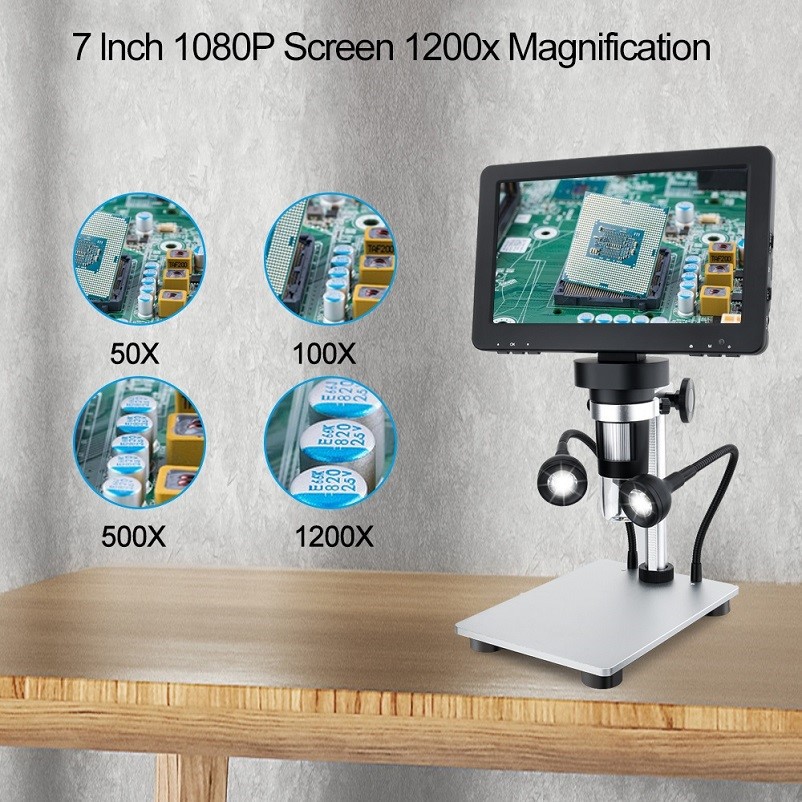
Several points to pay attention to when using an optical microscope correctly
1, Correct installation issues
Before using a microscope, first install the eyepiece and objective lens of the microscope. The installation of the eyepiece is relatively simple, but the main problem lies in the installation of the objective lens. Due to the high value of the objective lens, if the thread is not properly fastened during installation, it is easy for students to fall to the ground and cause damage to the lens. Therefore, for safety reasons, it is emphasized that students should use their left index and middle fingers to support the objective lens when installing it, and then use their right hand to install it. This way, even if it is not properly installed, students will not fall to the ground.
2, Correct alignment of light issues
Focusing on light is an important step when using a microscope. Some students randomly rotate an objective lens towards the light hole when focusing on light, instead of using a low magnification lens as required. When rotating the reflector, I like to use one hand and often pull it down. So when guiding students, teachers must emphasize the use of low magnification mirrors for light. When the light is strong, small aperture and flat mirrors should be used, while when the light is weak, large aperture and concave mirrors should be used. Reflectors should be rotated with both hands until a uniformly bright circular field of view is seen. After aligning the light, do not move the microscope casually to prevent light from accurately passing through the reflector and entering the light hole.
3, The problem of correctly using the quasi focal screw
Using a focus screw to adjust the focal length and find the object can be said to be an important step in the use of a microscope, and it is also a difficult step for students. Students are prone to the following errors during the operation process: firstly, focusing directly under a high-power lens; The second is that regardless of whether the barrel rises or falls, the eyes always look into the eyeglass to see the field of view; The third reason is that the critical value of the object distance is not understood. When the object distance is adjusted to 2-3 centimeters, it is still upward, and the speed of rotating the quasi focal screw is very fast. The first two types of errors often result in the objective lens colliding with the mounting, damaging the mounting or lens, while the third type of error is a common phenomenon among students when using a microscope. In response to the above errors, teachers must emphasize to students that adjusting the focal length must be done by lowering the magnification of the low magnification lens. First, rotate the coarse focus screw to slowly lower the lens barrel, and the objective lens should be close to the glass slide, but be careful not to let the objective lens touch the glass slide. During this process, the eyes should look at the objective lens from the side, then gaze into the objective lens with the left eye, and slowly adjust the coarse focus screw in the opposite direction until the object image is seen. At the same time, explain to students that the objective distance of a general microscope is about 1 centimeter. Therefore, if the objective distance has exceeded 1 centimeter but the object image is still not seen, it may be that the specimen is not in the field of view or the coarse focus screw rotates too fast. At this time, adjustments should be made. Install the film position, then repeat the above steps. When there is a blurry object in the field of view, you need to use a fine focus screw adjustment. Only in this way can you, To narrow down the search range and improve the speed of finding objects and images.
4, The problem of objective lens conversion
After using a low-power lens and switching to a high-power lens, students often prefer to use their fingers to directly rotate the objective lens, thinking it is more labor-saving. However, this can easily cause the optical axis of the objective lens to deviate. The reason is that the material of the converter is relatively soft, with high accuracy, and the threads are easily loosened due to uneven force. Once the thread is damaged, the entire converter will be scrapped. Teachers should guide students to hold the lower rotating plate of the converter and convert the objective lens.
5, The problem of using the eyes correctly
When observing objects under a microscope, both eyes should be open at the same time, and the left eye should gaze into the eyepiece. But many students often fail to achieve this, preferring to cover their right eye with their hands or simply close it, which does not meet the observation requirements of the experiment. This bad habit can cause left eye fatigue and cannot achieve the ability to observe while drawing. While pointing out the student's problem, the teacher should demonstrate in detail that the left eye should be as close to the eyepiece as possible, and the right eye should try to gaze into the field of view. This repeated training will achieve the requirement of both eyes opening for observation. Alternatively, you can do the following exercises: open your eyes, stand a piece of paper or palm between your eyes, with your nose in front of you, so that your left and right eyes cannot look at each other on the opposite side. Then, consciously look to the left first and then to the right, doing this 3-5 times a day in the morning and evening. You can learn it in less than a star period.
The use or operation errors of microscopes are a common phenomenon in biological experiments. As long as we take them seriously, consciously correct them, overcome them, and proficiently and correctly use microscopes, it is completely possible to do so.