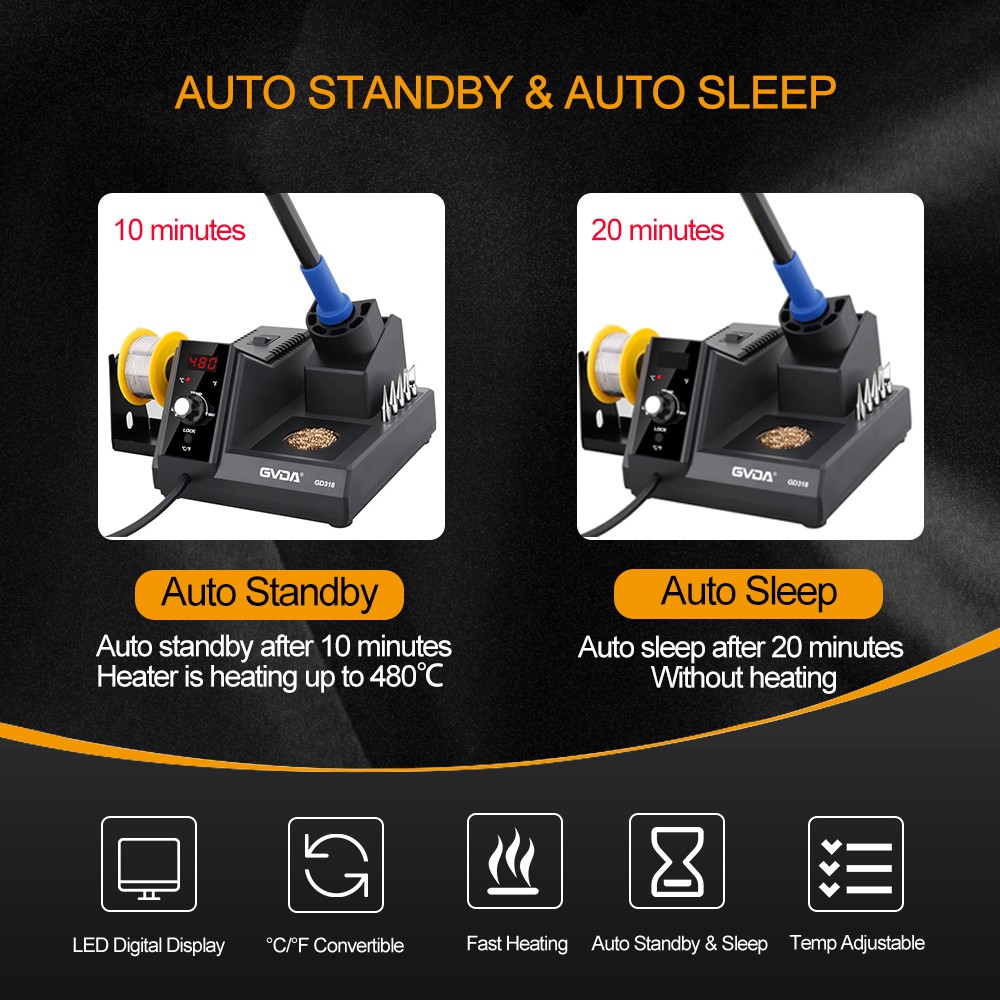
A soldering station is a hand tool commonly used in electronic soldering processes to weld two workpieces together by applying heat to the solder (usually referred to as tin wire), causing it to melt.
Digital display soldering station
Digital display soldering station
In order to protect the environment, countries have banned the use of lead-containing solder wires, which increases the soldering temperature because the melting point of lead-free tin wires is higher than that of lead tin wires. For the temperature compensation of the soldering station, there are higher requirements for the heating and temperature recovery speed. The heating and temperature recovery speed is an important indicator to determine the production efficiency. Therefore, the choice of a good soldering station depends on its temperature control ability. This is the huge gap with traditional soldering irons.
There are many ways to control temperature, but one of the simplest is adjustable power control, where the soldering station controls the temperature by rapidly transferring heat to the workpiece through the soldering iron. Another method is to use a thermostat to control the temperature by turning the power on or off. There is also a more advanced solution, which uses an integrated chip to detect the temperature of the soldering iron tip, and then adjusts the power of the thermostat to control the temperature. When the temperature of the soldering iron tip is lower than the set temperature, the host is turned on, and the power is supplied to the thermostat to heat up. When the temperature of the soldering iron tip is higher than the preset temperature, the host is turned off and stops heating.