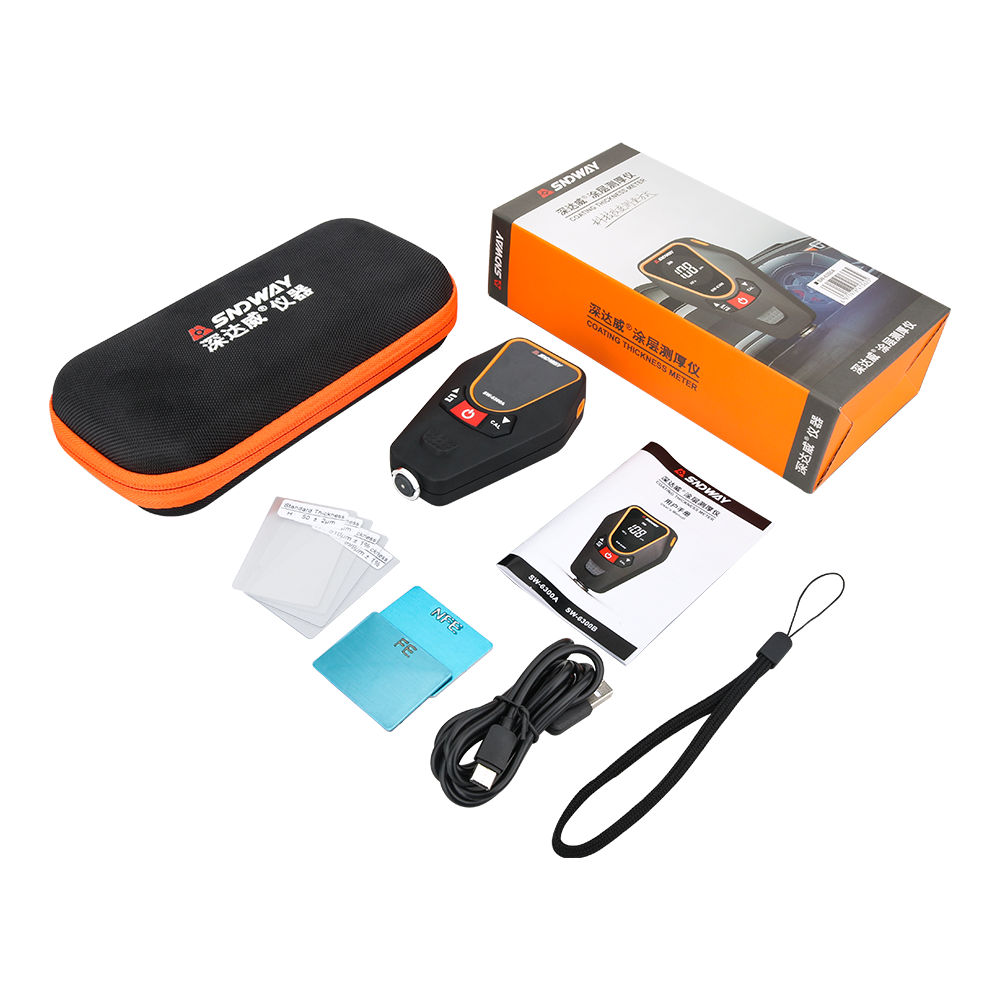
Solution to reduced sensitivity of coating thickness gauge probe
Under normal circumstances, the main unit of the coating thickness gauge is not easy to break and can be used for a long time under normal use. However, the sensitivity of the probe will decrease after reaching a certain service life. Especially if you do not follow the specifications during use, it can easily cause the sensitivity of the probe to decrease. After the sensitivity of the probe is reduced, it will be impossible to zero-calibrate, and the measuring host will have no display on the zero board. There is another phenomenon that can be displayed on a zero plate with poor surface roughness, but cannot be measured on a zero plate with good surface roughness. When this happens, it means that the probe has been damaged, but it can still be used. There are two ways to solve the problem when the probe sensitivity is reduced.
1. Place the probe on the edge of the zero plate for zero calibration. Measurement cannot be done in the middle of the zero plate. Generally, the edge of the zero plate can still be measured and displayed.
2. Use a very thin diaphragm to measure to see how big the reading error is (take the average), then remember this error, and subtract this error every time you measure in the future, then you will have an accurate reading.
Several methods commonly used in coating thickness gauges
When using the principle of magnetic induction, the thickness of the coating is measured by using the magnitude of the magnetic flux flowing from the probe through the non-ferromagnetic coating and into the ferromagnetic substrate. The corresponding magnetic resistance can also be measured to indicate the coating thickness. The thicker the coating, the greater the magnetic resistance and the smaller the magnetic flux. Thickness gauges that use the principle of magnetic induction can in principle have the thickness of non-magnetic conductive coatings on magnetically permeable substrates. Generally, the magnetic permeability of the base material is required to be above 500. If the coating material is also magnetic, the difference in magnetic permeability from the base material is required to be large enough (such as nickel plating on steel). When the probe with the coil around the soft core is placed on the sample being tested, the instrument automatically outputs the test current or test signal. Early products used a pointer-type meter to measure the magnitude of the induced electromotive force. The instrument amplified the signal and then indicated the coating thickness. In recent years, circuit design has introduced new technologies such as frequency stabilization, phase locking, and temperature compensation, and magnetoresistance is used to modulate measurement signals. It also uses designed integrated circuits and introduces microcomputers, which greatly improves the measurement accuracy and reproducibility (almost by an order of magnitude). Modern magnetic induction thickness gauges have a resolution of 0.1um, an allowable error of 1%, and a measuring range of 10mm.
The magnetic principle thickness gauge can be used to accurately measure the paint layer on the surface of steel, the porcelain and enamel protective layer, the plastic and rubber coating, various non-ferrous metal plating layers including nickel and chromium, and various anti-corrosion coatings in the chemical and petroleum industries. coating.