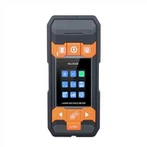
Special functions and applications of multimeters
Multimeters have become an indispensable tool in the hands of electrical and electronic engineers because of their many functions and ease of use. However, if you want to give full play to its role, you can get accurate data quickly and accurately. Then we need to have a deeper understanding of some characteristics of multimeters:
1. Is a digital multimeter necessarily better than an analog multimeter?
Solution: Digital multimeters are rapidly being used due to their excellent qualities such as high accuracy and sensitivity, fast measurement speed, multiple functions, small size, high input impedance, easy observation and powerful communication functions. There is a trend to replace analog pointer watches.
However, in some situations, such as situations where electromagnetic interference is very strong, the data tested with a digital multimeter may deviate greatly, because the input impedance of the digital multimeter is very high and is easily affected by the induced potential.
2. During maintenance, it is suspected through troubleshooting that the diode or transistor in the circuit may be damaged. But use the diode scale of the digital meter to measure the conduction voltage of about 0.6V, and the reverse direction is infinite. There is no problem. No fault was found after checking the circuit. Why?
Solution: The test voltage emitted by the diode range of most digital meters is about 3 to 4.5V. If the transistor under test has slight leakage or the characteristic curve has deteriorated, it will not be visible at such a low voltage. At this time, you need to use the analog meter × 10K resistance setting. The test voltage issued by this setting is 10V or 15V. Under this test voltage, it will be found that the suspected transistor has leakage in the reverse direction. Similarly, when measuring the resistance of some precision sensitive components with very low withstand voltage, using an analog meter can easily damage the sensitive components. At this time, you need to use a digital meter to measure.
3. Use a multimeter to measure the attenuated voltage value of the high-voltage probe. It is found that the DCV test is more accurate, but the ACV error is very large. This is true even with a highly accurate multimeter. Why?
Solution: Most multimeters measure voltage in parallel. For the entire test circuit, the voltmeter itself is equivalent to a load, which is the input impedance. The larger the load impedance, the less impact it will have on the circuit under test, and the more accurate the test will be. But nothing can be perfect. If the impedance is high, the bandwidth of the test will be sacrificed. The input impedance of multimeters currently on the market with a frequency response of around 100KHz is around 1.1M, so it will have a great impact when testing the voltage at the 2-end of a high-impedance load. For example, the resistance of the high-voltage probe itself is very high. At this time, you should choose a multimeter with high internal resistance, such as the ESCORT 170/172/176/178/179 handheld digital multimeter that provides an input impedance of up to 10000Ω when testing ACV, so as to avoid this problem.
4. During the actual test, I not only want to measure the voltage, current, impedance of the motor winding, etc., but also want to measure the rotation speed. Is there a multimeter that can achieve this function?
Solution: ESCORT-172 handheld digital multimeter can meet your above requirements. At the same time, its safety regulations meet the International Electrotechnical Commission IEC1010-1 CATII 1000V, CATIII 600V standards, so you can even in Category III environments. Feel free to use it without worrying about safety issues.
5. Is there a very cheap digital multimeter with reliable and stable performance?
Answer: If there is such a good thing in the world, please tell me:). But relatively speaking, the digital multimeters produced by Taiwan's ESCORT are more cost-effective.
6. What is traceability?
Solution: Traceability is the characteristic that enables measurement results or measurement standard values to be linked to a specified reference standard, usually a national measurement standard or an international measurement standard, through a continuous comparison chain with a specified uncertainty. That is, working measuring instruments----->Measurement standard instruments----->Measurement reference instruments. For example, the unit of mass that everyone comes into contact with most in life is the kilogram. Its standard is based on the mass of a 1-kilogram platinum-iridium alloy cylindrical weight stored in a triple-locked safe in a castle in Sèvres, Paris. All mass units are based on this. Similarly, DCV 1V/10V is based on the Josephson quantum voltage array stored at the International Bureau of Weights and Measures in Paris.