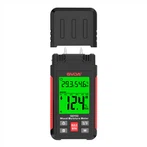
Structure of the sensor and principle of the anemometer
The basic principle of an anemometer is to place a thin metal wire in a fluid, apply current to heat the wire, and make its temperature higher than the temperature of the fluid. Therefore, the metal wire anemometer is called "". When the fluid flows through the metal wire in a vertical direction, it will take away some of the heat from the wire, causing the temperature of the wire to decrease. According to the theory of forced convective heat exchange, the relationship between the dissipated heat Q and the fluid velocity v can be derived using an anemometer. The standard probe consists of two brackets tensioned with a short and thin metal wire, as shown in Figure 2.1. Metal wires are usually made of metals with high melting points and good ductility, such as platinum, rhodium, tungsten, etc. The commonly used wire diameter is 5 μ m and the length is 2mm; The smallest probe has a diameter of only 1 μ m and a length of 0.2mm.
Anemometers can provide the most primitive recorded wind speed and direction data in industries such as hydrological stations, environmental protection, agriculture, forestry, power plants, islands, transportation, and mining sites.
The sensor of the anemometer adopts a traditional two cup rotating frame structure. It converts wind speed into the rotational speed of the rotating frame.
In order to reduce the starting wind speed, special materials such as lightweight wind cups and gemstone bearings are used for support. The signal is transmitted to the host for measurement after being detected by sensors through a device fixed on the rotating frame.
The microcontroller inside the anemometer samples, calibrates, and calculates the output signal of the wind sensor;
The instrument outputs five parameters of wave height corresponding to instantaneous wind speed/one minute average wind speed/instantaneous wind level/one minute average wind level/average wind level.
The measured parameters are displayed directly on the instrument's LCD screen using numbers.
In order to reduce the power consumption of the instrument, sensors and microcontrollers in the instrument have taken a series of specialized measures to reduce power consumption.
In order to ensure the reliability of the data, when the power supply voltage is too low, the battery label at the bottom of the display shows a power shortage, indicating to the user that the power supply voltage is too low and the data is no longer reliable, and the battery needs to be replaced in a timely manner.