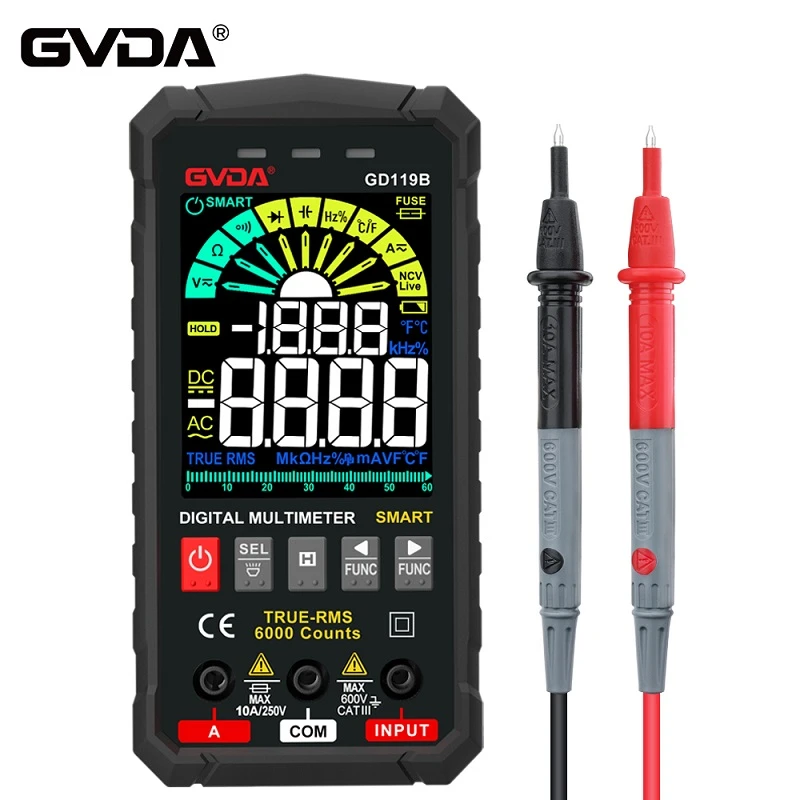
Summary of Practical Tips for Digital Multimeters
1. Judge whether a circuit or component is live
The AC voltage range of a digital multimeter is highly sensitive and can display even weak induced voltage from surroundings. Based on this feature, the multimeter can be used as a test pencil.
Operation: Set the multimeter to the AC 20V range. Leave the black test lead floating in the air. Hold the red test lead and touch it to the circuit or component under test. A reading of several volts to more than ten volts (readings vary among different multimeters) indicates the circuit or component is live. A zero or very low reading means it is not live.
2. Distinguish live wire and neutral wire of power supply cables
Method 1: Use the method described above. The wire with a larger reading is the live wire; the one with a smaller reading is the neutral wire. This method requires physical contact with the tested circuit or component.
Method 2: No direct contact required. Set the multimeter to the AC 2V range. Leave the black test lead floating. Hold the red test lead and slide its tip gently along the wire path. A reading of several volts indicates it is the live wire; a reading of only tenths of a volt or lower means it is the neutral wire. This non-contact detection method is safe, convenient and fast.
3. Locate cable breakpoints
The traditional method uses the resistance range to check cable segments one by one to find breakpoints. It is time-consuming and may seriously damage cable insulation. The induction feature of a digital multimeter enables fast location of cable breakpoints.
First, use the resistance range to identify which cable core is broken. Connect one end of the broken core to the 220V power supply. Set the multimeter to AC 2V and leave the black test lead floating. Slide the tip of the red test lead gently along the cable. If the reading suddenly drops sharply at a certain position, mark this spot. Generally, the breakpoint is 10~20 cm ahead of this position. This method can also find open-circuit faults in resistance wires such as faulty electric heating blankets.
4. Measure the frequency of UPS power supply
For a UPS power supply, the stability of output voltage is an important parameter, and its output frequency is also critical. The frequency range of a digital multimeter cannot be used for direct measurement because its frequency input can only withstand very low voltage (only a few volts).
Connect a 220V/6V or 220V/4V step-down transformer to the UPS output terminal. The transformer reduces the voltage without changing the power frequency. Then connect the frequency range terminals to the transformer output, and the UPS frequency can be measured.