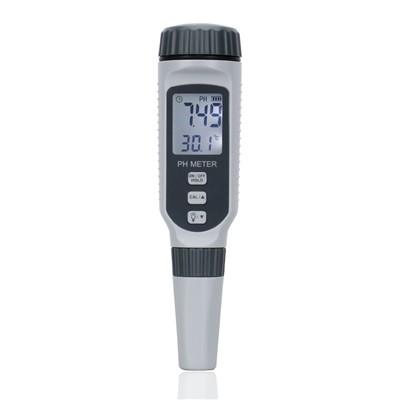
Temperature compensation function of pH meter and calibration method of pH meter electrode
The temperature compensation of the pH meter should include three parts: temperature compensation of the electrode slope and temperature compensation of the electrode zero point (including the measuring electrode and the reference electrode). The temperature compensation set on the pH meter only compensates for the slope term of the electrode (2.303RT/F). Therefore, temperature compensation is not very sufficient for pH meter measurement, nor can it completely eliminate errors caused by temperature. It's just that the temperature term of the solution and the zero point temperature term of the electrode cannot be determined, and the errors caused by them are very small, so they are omitted.
Common sense about pH electrode calibration
After the pH electrode is used for a period of time, the asymmetric potential will change greatly, so it must be calibrated regularly.
The number of pH meter electrode calibrations depends on the sample, electrode performance and measurement requirements. High-precision measurement (≤±0.03pH) should be calibrated in time; general-precision measurement (≤±0.1pH) can be used continuously for two weeks or even longer after one calibration.
As long as the measurement shows that the pH value is accurate, there is absolutely no need to calibrate the electrode frequently. First test a standard solution that is closer to the solution being tested, and determine whether recalibration is needed based on the size of the error.
Main functions of each component
The basic function of the reference electrode is to maintain a constant potential as a control for measuring various deviation potentials. Silver-silver oxide electrode is currently the most commonly used reference electrode in pH.
The function of the glass electrode is to establish a potential difference that responds to changes in the hydrogen ion activity of the solution being measured. Putting the pH-sensitive electrode and the reference electrode in the same solution forms a primary cell. The potential of the cell is the algebraic sum of the potentials of the glass electrode and the reference electrode. E battery = E reference + E glass. If the temperature is constant, the potential of this battery changes with the pH of the solution to be measured. It is difficult to measure the potential generated by the battery in the pH meter because the electromotive force is very small and the circuit The impedance is very large, 1-100MΩ; therefore, the signal must be amplified enough to drive a standard millivoltmeter or milliammeter.