Temperature sensors are divided into several categories according to the measurement method
1. Contact
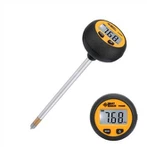
The detection part of the contact temperature sensor is in good contact with the measured object, also known as a thermometer.
The thermometer achieves heat balance through conduction or convection, so that the indication value of the thermometer can directly represent the temperature of the measured object.
Generally, the measurement accuracy is relatively high. Within a certain temperature range, the thermometer can also measure the temperature distribution inside the object. However, large measurement errors will occur for moving bodies, small targets or objects with small heat capacity. Commonly used thermometers include bimetallic thermometers, liquid-in-glass thermometers, pressure thermometers, resistance thermometers, thermistors, and thermocouples. They are widely used in industry, agriculture, commerce and other sectors. People also often use these thermometers in daily life.
2. Non-contact
Its sensitive components are not in contact with the measured object, so it is also called non-contact temperature measuring instrument. This instrument can be used to measure the surface temperature of moving objects, small targets and objects with small heat capacity or rapid temperature changes (transient), and can also be used to measure the temperature distribution of the temperature field.
The most commonly used non-contact thermometer is based on the basic law of black body radiation, called radiation thermometer. All kinds of radiation temperature measurement methods can only measure the corresponding photometric temperature, radiation temperature or colorimetric temperature. Only the temperature measured for a black body (an object that absorbs all radiation and does not reflect light) is the true temperature. If you want to measure the real temperature of the object, you must correct the surface emissivity of the material. However, the surface emissivity of materials depends not only on temperature and wavelength, but also on surface state, coating film and microstructure, so it is difficult to measure accurately.
The advantage of the non-contact temperature sensor is that the upper limit of measurement is not limited by the temperature resistance of the temperature sensing element, so there is no limit to the maximum measurable temperature in principle.