The advantages and disadvantages of using a digital multimeter to measure capacitance
1. To determine polarity, first set the multimeter to the 100 or 1K ohm range. Assuming one pole is the positive pole, connect the black probe to it and the red probe to the other pole, record the resistance value, and then discharge the capacitor, allowing the two poles to come into contact. Then change the probe to measure resistance. The black probe with the highest resistance value is connected to the positive pole of the capacitor.
2. Set the multimeter to the appropriate ohm range. The principle for selecting the appropriate range is: 20K range for capacitors with 1 μ F, 2K range for capacitors with 1-100 μ F, and 200 range for capacitors larger than 100 μ F.
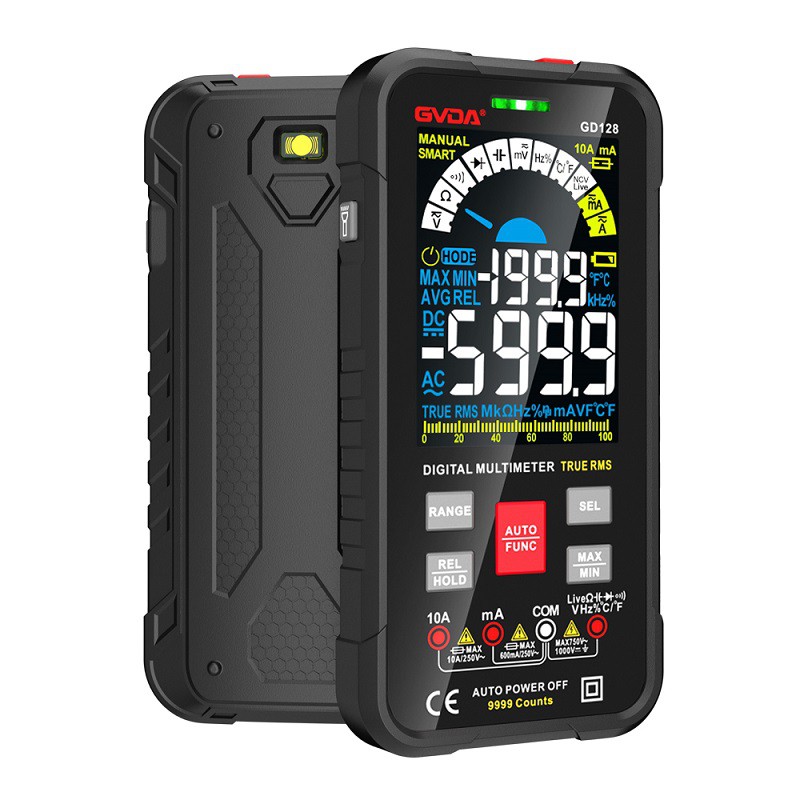
3. Then use the red pen of the DT2201D multimeter to connect to the positive pole of the capacitor, and the black pen to connect to the negative pole of the capacitor. If the display gradually increases from 0, and finally shows the overflow symbol 1, the capacitor is normal. If it always shows 0, it is a short circuit inside the capacitor. If it always shows 1, it is an open circuit inside the capacitor.
1, Determine the location of wire core breakage [nuclear phase analyzer]
Method: Connect one end of the broken insulation wire to a 220V AC power live wire, and suspend the other end in the air. Turn the digital multimeter to the 2V position, start from the live wire end, and move the red probe along the insulation outer skin of the wire. The displayed voltage value should jump around a few tenths of a volt. When the red probe moves to a certain position, the voltage suddenly drops to just over zero volts, indicating that this must be the location of the broken core.
Due to the high sensitivity of the AC gear of the digital multimeter, it can accurately determine the live wire without touching the internal copper wire, and only touching the outer skin of the two power lines. The method is as described above. Due to the fact that the probe tip did not touch the copper wire inside, the induced voltage is relatively small, so a gear with a smaller range should be selected.
2, Distinguishing between "zero" and "fire" money in mains electricity
Turn the multimeter to the AC 20V position, remove the black probe, hold the insulated rod of the red probe, and use the tip of the pen to sequentially touch the two holes in the power socket. The one with the higher value displayed is the "fire" line, and the one with the lower value displayed is the "zero" line.