The history of multimeters
The first pointer meter for measuring current, called the galvonometer, was invented in 1820. Using the Wheatstone Bridge in conjunction can compare the unknown resistance and voltage to be measured with the known voltage and resistance, and then measure the relevant voltage, current, resistance, etc. Using this method to measure in the laboratory is laborious and inconvenient. This device is cumbersome and complicated and not easy to carry.

▲ Galvanometer
The galvanometer can only roughly reflect the existence of current, but cannot give the precise value of the current magnitude. The ammeter using the active coil mechanism (D'Arsonval/Weston transmission mechanism) can display the magnitude of the current.
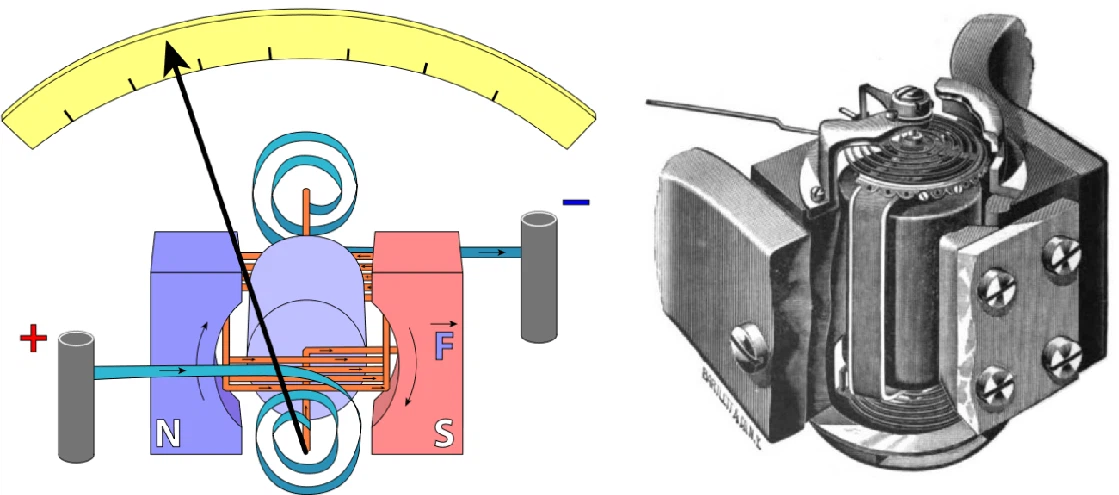
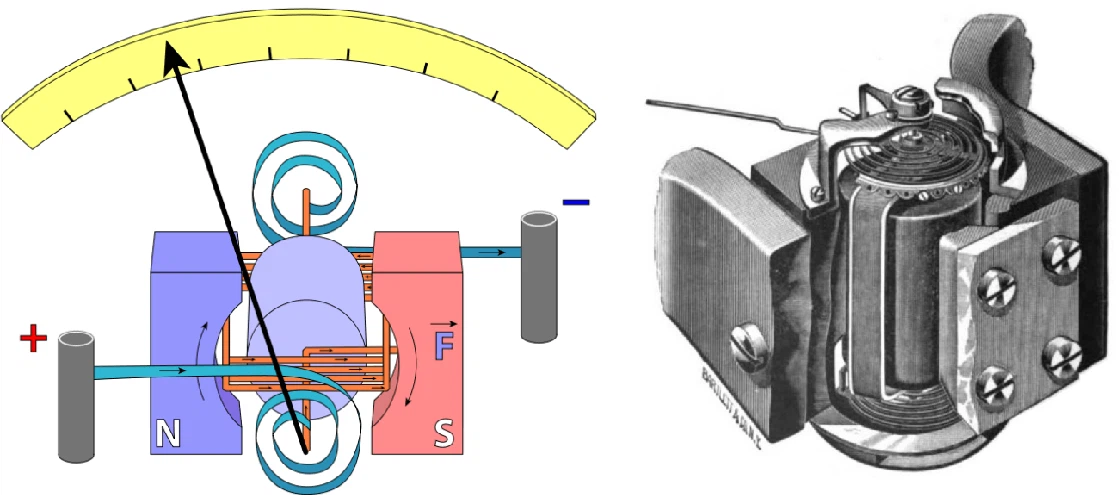
The hollow coil wound with fine enameled wire is suspended in the magnetic pole of the permanent magnet, and the rotating torque can be generated after passing the DC current to drive the pointer to rotate. The magnetic field is designed as a circular ring, so that the ampere force on the current coil has nothing to do with the angle, and a thin metal spring wire generates a restoring torque, which makes the angle between the rotation of the pointer and the current passing through the coil. proportional. This mechanism, known as the D’Arsonval gear mechanism, is still widely used in analog electronic watch heads of all kinds.
▲ D'Arsonal transmission mechanism
An ammeter based on a moving coil mechanism eliminates the need for a Wheatstone bridge to easily and conveniently measure current. On this basis, by adding shunt resistance, series resistance and stable DC power supply, the voltage, current and resistance of different gear ranges can be measured.
In the 1820s, as tube devices became more widely used, the multimeter was born. It is said that the first multimeter in the modern sense was invented in 1920 by Donald Macaie, an engineer at the British Post Office. In his work, in order to maintain communication facilities, it is necessary to continuously measure voltage, current, resistance, etc. in the circuit. He couldn't stand the trouble of carrying multiple meters at the same time, so he developed a multimeter that can measure voltage, current and resistance at the same time, which was called the Avometer at that time.

▲ Donald Macadie's multimeter
The Amvohm multimeter adopts a pointer ammeter with an active coil mechanism, and is equipped with a precision voltage divider and shunt resistance. It uses a gear switch and socket to select the measurement category and process range.
Macadie transferred the Avometer he designed to the Automatic Winding and Electrical Equipment Company (ACWEEC, established in 1923), and it became a commercial production and sales that year. Avometer, before the improved 8, can only measure DC voltage and current signals.
A pocket watch-style voltmeter was also popular at the time, with a metal casing, which was much cheaper than the Avometer. Its shell is usually connected to the negative terminal of the meter. Although this simplification was convenient for operation, it also caused many careless electronic engineers at that time to suffer a lot of electric shocks.
This kind of watch is usually relatively simple. For example, the manual only indicates 33Ω/V, the dial is often not uniform, and there is no pointer zero adjustment screw.
▲ Pocket watch voltmeter
The pointer-type multimeter usually needs to absorb a certain current from the measured circuit to drive the rotating coil, such as a full-scale 50 microampere meter, a commonly used high-sensitivity meter. During measurement, if the pointer is fully offset, it needs to continue to receive 50 microamps of current from the circuit under test, which will affect the measurement results of some high-impedance circuits, making the read value lower than the normal value.
It is necessary to use vacuum tubes to increase the input impedance of the multimeter, and they are called vacuum tube multimeters (VTVM, VVM). This electronic vacuum tube multimeter usually has an input impedance of more than 1MΩ. It uses a vacuum tube cathode follower output (voltage series negative feedback) circuit to increase the input impedance, so that the multimeter will not have a significant impact on the circuit under test during measurement.

▲ Vacuum tube multimeter
Before the invention of the digital (integrated) multimeter, high impedance analog transistor circuits, or Field Effect Triodes (FETs), were used to replace vacuum tubes in multimeter devices. Modern digital multimeters use high-impedance integrated circuits, with input impedances that can match or exceed the original vacuum tube multimeters.

▲ Modern digital multimeter
Today's multimeters have added many additional functions, such as decibel meters for measuring power, measuring capacitance, triode gain, frequency, duty cycle, display hold and so on. The buzzer on the multimeter can sound when the measurement circuit is on and off, giving quick measurement feedback.