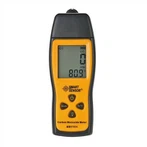
The main performance of radiation detectors
(1) Quantum detection efficiency (DQE) is the efficiency with which a detector converts an input radiation signal into an output signal. The input signal strength and the output signal strength are usually represented by the number of particles or photons. Quantum efficiency is related to the type of detector, the type and energy of incident rays, etc. It directly affects the resulting image quality.
(2) Sensitivity refers to the minimum input signal strength required for the detector to output a detectable signal. Good detectors have sensitivity down to one photon.
(3) The dynamic range is the range in which the detector output signal is proportional to the input signal, also known as the linear range.
(4) Noise refers to output signals caused by non-input signals.
(5) Time resolution is the minimum time interval between two adjacent incident particles that can be resolved by the detector.
(6) Energy resolution is the ability of the detector to distinguish particles of different energies, usually divided by the half-height width of the output pulse of a certain energy by the pulse height.
(7) Spatial resolution is the ability of the detector to resolve the smallest geometric details, and it is usually expressed by spatial frequency (modulation transfer function reduced to 0.2) or unsharpness. It should be noted that the spatial resolution is dependent on the specific technique employed.