The most important things to consider when choosing an infrared thermometer are as follows:
In terms of performance indicators, such as:
Temperature measurement range: Each model of thermometer has its own specific temperature measurement range, which should not be too narrow or too wide. Generally speaking, the narrower the temperature measurement range, the higher the resolution of the output signal for monitoring temperature, and the accuracy and reliability are easy to solve. If the temperature measurement range is too wide, it will reduce the temperature measurement accuracy
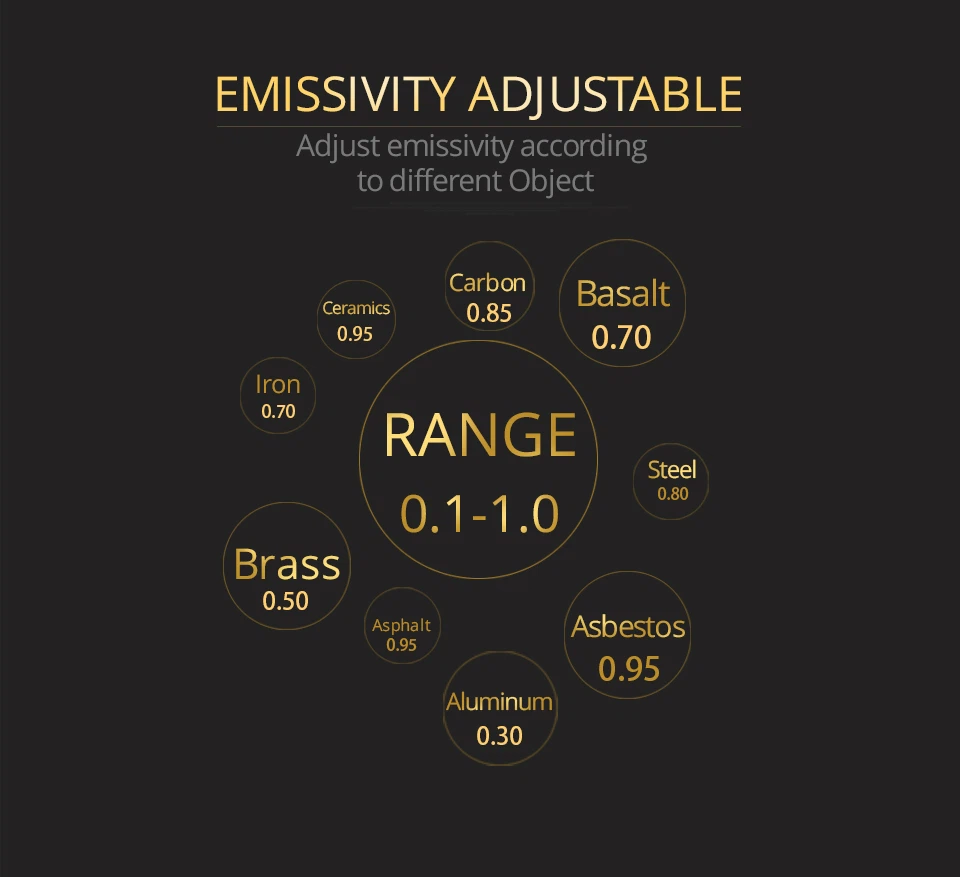
Working wavelength: According to the blackbody radiation law, the change in radiation energy caused by temperature in the short wavelength of the spectrum will exceed the change in radiation energy caused by emissivity error. Therefore, short waves should be used as much as possible for temperature measurement, but emissivity factors must also be considered in conjunction with the detected object
The emissivity and surface characteristics of the target material determine the corresponding wavelength of the thermometer's spectrum. For high reflectivity alloy materials, there is a low or varying emissivity. In the high temperature zone, the measurement wavelength of metal materials is near-infrared, which can be selected as 0.8-1.0 μ m. Other temperature zones can use 1.6, 2.2, and 3.9 μ m. Due to the transparency of some materials at certain wavelengths, infrared energy can penetrate these materials. Therefore, special wavelengths should be selected for these materials, such as measuring the internal temperature of glass using wavelengths of 1.0, 2.2, and 3.9 μ m (the measured glass must be very thick, otherwise it will pass through); Select 5.0 μ m for measuring the surface temperature of the glass; It is advisable to use 8-14 μ m for measuring low temperature zones, such as 3.43 μ m for measuring polyethylene plastic film, 4.3 or 7.9 μ m for measuring polyester, 8-14 μ m for measuring thicknesses exceeding 0.4mm, 4.64 μ m for measuring CO in flames, 4.47 μ m for measuring NO2 in flames, etc.
Spot size: The area of the measuring point of a thermometer is called the "spot size". In order to obtain a temperature reading, the distance between the thermometer and the test target must have an appropriate range. The farther away from the target, the larger the spot size. Therefore, in applications, attention should be paid to the ratio of distance to spot size, also known as D: S. When determining the measurement distance, attention should be paid to making the target diameter equal to or greater than the size of the measured light spot. If the target is smaller than the size of the measured light spot, the thermometer will simultaneously measure the temperature of the background object, thereby reducing the accuracy of the reading.