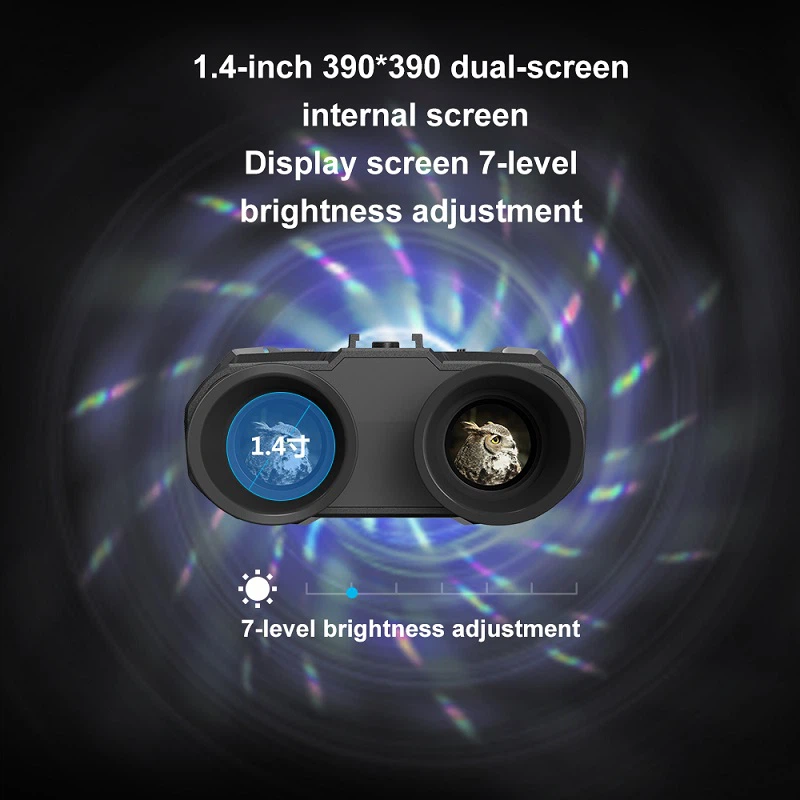
The principles and the characteristics of the different types of night vision devices.
1, Active infrared night vision device.
Principle: The instrument emits an infrared beam outward, illuminating the target and converting the reflected infrared image into a visible light image for night observation. It is mainly used for night time aiming, driving vehicles, reconnaissance photography, etc.
Features: Not limited by illumination, can be observed in all black conditions, and the effect is very good, with a cheap price.
However, due to the close observation distance, it is easy for the other party to notice and expose oneself during observation, which is rarely used nowadays.
Nowadays, it is mainly used for civilian use, and there are many products in this field, such as Doctoral Energy and ATN.
2, Low light night vision instrument.
Principle: The instrument utilizes natural light such as low brightness night sky, star, moon, atmospheric glow, etc. reflected by nighttime targets to enhance and amplify them to hundreds of thousands of times, thus achieving suitability for reconnaissance, observation, aiming, vehicle driving, and other battlefield operations with the naked eye at night.
Features: As the low light night vision system uses night sky light for operation and operates in a passive manner, it can better conceal itself. It is suitable for departments engaged in special work, such as * *, criminal investigation, drug collection, privacy collection, night monitoring, and security applications.
The low light night vision system has developed three generations, with the first generation being a three-level cascaded low light night vision system (consisting of three Generation 0 phototubes in series). The second generation is a microchannel plate type low light night vision device, and the third generation is a | | | - V group negative electron affinity photocathode image intensifier low light night vision device. During the transition from the first generation to the third generation, a super second-generation photocell called the second-generation plus was developed, with its technical performance second only to the third-generation products. If classified in detail, the low light night vision device can be divided into five levels: Generation 0, Generation 1, Generation 2, Generation 2 plus, and Generation 3. The development of low light night vision devices to this day is relatively mature in technology, with good imaging quality and low cost. Therefore, for a considerable period of time in the future, they will still be a major equipment in the world's night vision equipment. The second-generation and third-generation products have the characteristics of small size, light weight, clear images, full functionality, and practicality. It is an essential equipment for night work in public security, armed police, customs, petroleum industry, news reporting, tourism, aquaculture, nature enthusiasts, and other industries. However, due to its core component, the low light image intensifier, being a high-tech product, the process is particularly complex, the cost is high, and the price is relatively high. But in terms of cost-effectiveness, it is still quite good.
3, Thermal imaging infrared instrument
Principle: Thermal imaging infrared instrument is an instrument that discovers and identifies targets based on the basic principle that objects with temperatures above zero degrees Celsius (-273 ℃) emit infrared radiation, and utilizes the difference in infrared radiation between the target and the background itself.
Features: Due to the different intensities of infrared radiation from various objects, people, animals, vehicles, airplanes, etc. can be clearly observed, and are not affected by obstacles such as smoke, fog, and trees. They can work both day and night. It is currently the most advanced night vision observation equipment mastered by humans. However, due to its extremely high price, thermal imaging can only be applied to civilian markets. However, due to its wide range of applications, such as electricity, underground pipelines, fire and medical services, disaster relief, and industrial testing, there is a huge market for thermal imaging. With the development of social economy, scientific and technological progress, infrared thermal imaging, a high-tech technology, will undoubtedly be widely applied to civilian markets and make contributions to humanity in the next two to three decades. At present, low-priced thermal imaging on the market costs tens of thousands of yuan, let alone good ones. It won't become popular in the short term.