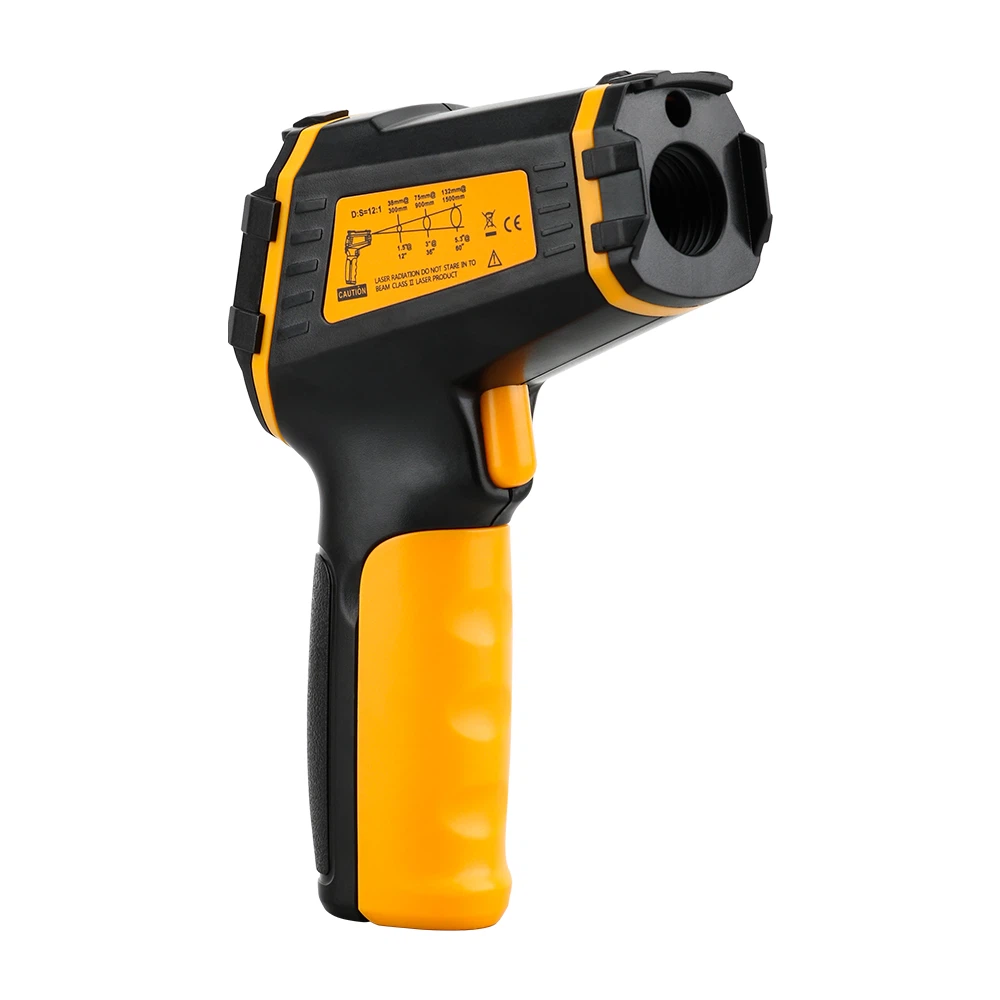
The ratio of the measurement distance of the infrared thermometer to the measurement target.
The optical system of the infrared thermometer collects energy from the circular measurement spot and focuses it on the detector. The optical resolution is defined as the ratio of the distance from the infrared thermometer to the object and the size of the measured spot (D:S). The larger the ratio, the better the resolution of the infrared thermometer and the smaller the measured spot size. Laser aiming is only used to help aim at the measurement point. The latest improvement in infrared optics is the addition of a close focus feature, which provides measurement of small target areas and prevents the effects of background temperature.
Infrared thermometers receive invisible infrared energy emitted by a variety of objects themselves. Infrared radiation is part of the electromagnetic spectrum, which includes radio waves, microwaves, visible light, ultraviolet, R-rays and X-rays. Infrared is located between visible light and radio waves. Infrared wavelengths are commonly expressed in microns, and the wavelength range is 0.7 microns-1000 microns. In fact, the 0.7 microns-14 micron band is used in infrared thermometers.
Infrared thermometers are lightweight, small, easy to use, and can reliably measure hot, dangerous, or hard-to-reach objects without contaminating or damaging the object being measured.
Infrared thermometers can be divided into single-color thermometers and two-color thermometers (radiation colorimetric thermometers) based on their principles. For a monochromatic thermometer, when measuring temperature, the measured target area should fill the field of view of the thermometer. It is recommended that the size of the measured target exceeds 50% of the field of view. If the target size is smaller than the field of view, the background radiation energy will enter the visual and acoustic signals of the thermometer and interfere with the temperature measurement reading, causing errors. In contrast, if the target is larger than the thermometer's field of view, the thermometer will not be affected by the background outside the measurement area. For colorimetric thermometers, the temperature is determined by the ratio of radiated energy in two independent wavelength bands. Therefore, when the measured target is small, does not fill the field of view, and there are smoke, dust, and obstructions on the measurement path, which attenuate the radiation energy, it will not have a significant impact on the measurement results. For small targets that are in motion or vibrating, colorimetric thermometers are the best choice. This is due to the small diameter and flexibility of light, which can transmit optical radiation energy in curved, blocked and folded channels.