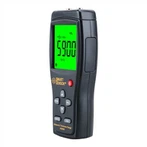
The thermometer determines the optical resolution (distance system is sensitive)
The optical resolution is determined by the ratio of D to S, which is the ratio of the distance D between the thermometer and the target to the diameter of the measurement spot S. If the thermometer must be installed far away from the target due to environmental conditions, and small targets need to be measured, a thermometer with high optical resolution should be selected. The higher the optical resolution, that is, the higher the D:S ratio, the higher the cost of the thermometer.
Determine wavelength range
The emissivity and surface properties of the target material determine the spectral response, or wavelength, of the thermometer. For high reflectivity alloy materials, there is low or varying emissivity. In high-temperature areas, the best wavelength for measuring metallic materials is near-infrared, and 0.18 to 1.0mm wavelengths can be used. Other temperature zones are available with 1.6mm, 2.2mm and 3.9mm wavelengths. Since some materials are transparent at certain wavelengths, infrared energy will penetrate these materials, and a special wavelength should be selected for this material. For example, when measuring the internal temperature of glass, use 1.0mm, 2.2mm and 3.9mm wavelengths (the glass to be measured must be very thick, otherwise it will be transmitted through); when measuring the internal temperature of glass, use 5.0mm wavelength; when measuring low temperatures, it is appropriate to use 8~14mm wavelength; For example, when measuring polyethylene plastic film, use 3.43mm wavelength, and when measuring polyester, use 4.3mm or 7.9mm wavelength. If the thickness exceeds 0.4mm, the wavelength of 8~14mm is selected; for example, the narrowband 4.24~4.3mm wavelength is used to measure CO2 in the flame, the narrowband 4.64mm wavelength is used to measure the CO in the flame, and the 4.47mm wavelength is used to measure the NO2 in the flame.