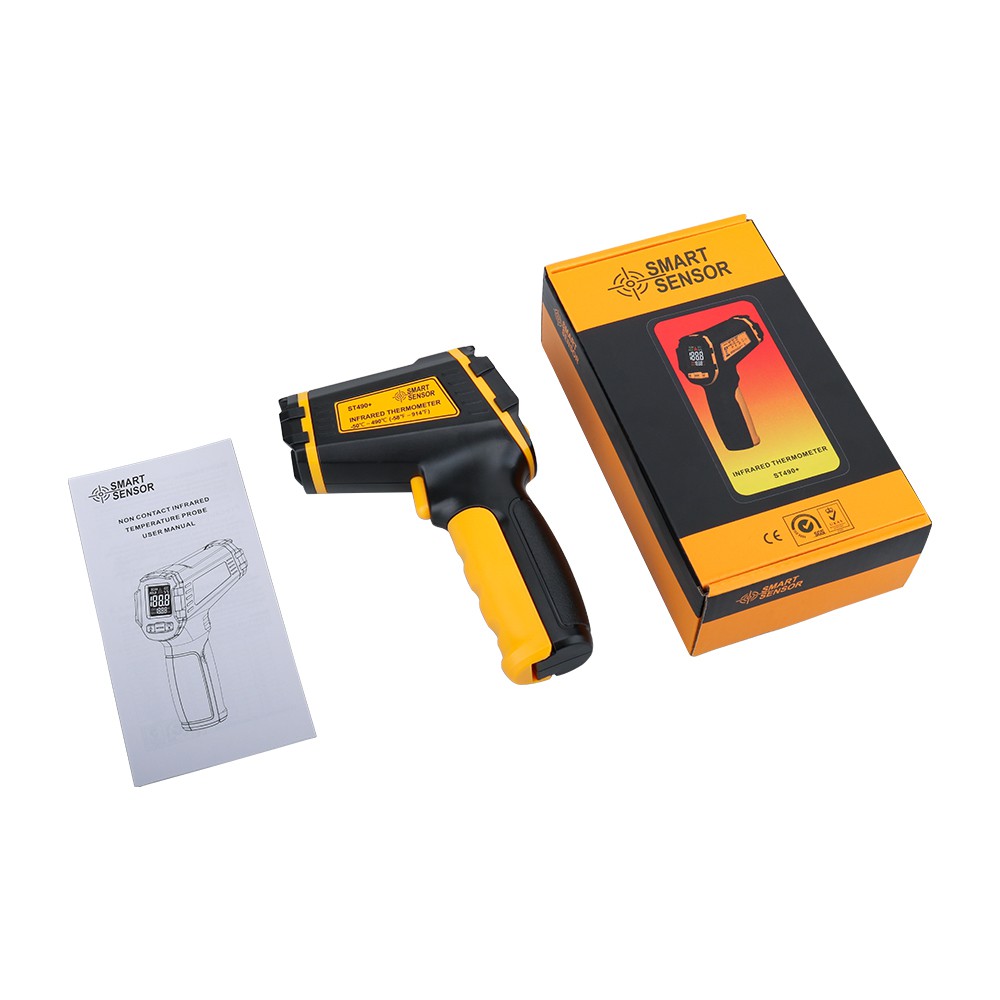
Discussion on the selection method of infrared thermometer
working principle
All objects with a temperature higher than relative zero are constantly emitting infrared radiation energy into the surrounding space. The infrared radiation characteristics of an object-the amount of radiated energy and its distribution by wavelength-are closely related to its surface temperature. Therefore, by measuring the infrared energy radiated by the object itself, its surface temperature can be accurately determined, which is the basis for infrared radiation temperature measurement.
When using an infrared radiation thermometer to measure the temperature of a target, the amount of infrared radiation of the target within its band range must first be measured, and then the temperature of the measured target is calculated by the thermometer. A single-color thermometer is proportional to the amount of radiation within the band; a two-color thermometer is proportional to the ratio of the amount of radiation in the two bands.
Infrared system
Infrared thermometer consists of optical system, photoelectric detector, signal amplifier, signal processing, display output and other parts. The optical system gathers the target infrared radiation energy within its field of view. The size of the field of view is determined by the optical parts of the thermometer and their positions. The infrared energy is focused on the photodetector and converted into a corresponding electrical signal. The signal passes through the amplifier and signal processing circuit, and is converted into the temperature value of the measured target after correction according to the internal treatment algorithm of the instrument and the target emissivity.
Choosing an infrared thermometer can be divided into three aspects:
(1) Performance indicators such as temperature range, spot size, working wavelength, measurement accuracy, response time, etc.; environmental and working conditions, such as ambient temperature, window, display and output, protective accessories, etc.; other options, such as ease of use , maintenance and calibration performance and price, etc., also have a certain impact on the choice of thermometer.
(2) Determine the temperature measurement range. The temperature measurement range is the most important performance indicator of the thermometer. Each model of thermometer has its own specific temperature measurement range. Therefore, the user's measured temperature range must be considered accurately and comprehensively, neither too narrow nor too wide. According to the blackbody radiation law, the change in radiant energy caused by temperature in the short-wavelength band of the spectrum will exceed the change in radiated energy caused by the emissivity error. Therefore, shortwave should be used as much as possible when measuring temperature.
(3) Determine the target size. Infrared thermometers can be divided into single-color thermometers and double-color thermometers (radiation colorimetric thermometers) according to their principles. For a monochromatic thermometer, when measuring temperature, the measured target area should fill the field of view of the thermometer. It is recommended that the size of the measured target exceeds 50% of the field of view. If the target size is smaller than the field of view, the background radiation energy will enter the visual and acoustic signals of the thermometer and interfere with the temperature measurement reading, causing errors. In contrast, if the target is larger than the thermometer's field of view, the thermometer will not be affected by the background outside the measurement area.