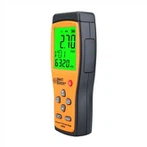
The use and testing of clamp-on ammeters
Usually when measuring current with an ordinary ammeter, you need to cut off the circuit to stop before the ammeter can be accessed for measurement, which is very troublesome, and sometimes the normal operation of the motor does not allow this to be done. At this time, the use of clamp-on ammeter is much more convenient, you can not cut off the circuit to measure the current. The principle of operation is as follows:
The clamp-on ammeter is a combination of a current transformer and an ammeter. The core of the current transformer in the pinch spanner can be open; the measured current through the wire can not have to cut through the core of the open gap, when the release of the wrench after the core closed. Through the core of the measured circuit wire becomes the primary coil of the current transformer, which passes through the current will be induced in the secondary coil current. Thus, the secondary coil connected to the ammeter will have an indication ----- of the current of the line under test. Clamp meter can be through the switch gear, change different ranges. However, it is not allowed to operate with electricity when switching gears. Clamp meter general accuracy is not high, usually 2.5 ~ 5 level. In order to facilitate the use of the meter, there are also different ranges of the switch for measuring different levels of current and voltage measurement function.
Usage
When using the clamp ammeter to detect the current, be sure to clamp a measured wire (wire). If two wires are clamped (parallel wires), the current cannot be detected. In addition, when using the centre (core) of the clamp ammeter, the detection error is small. When checking the power consumption of home appliances, it is more convenient to use a line separator, and some line separators can amplify the detection current by 10 times, so that currents below 1A can be amplified and then detected. When using a DC clamp ammeter to detect DC current (DCA), if the current flows in the opposite direction, it will show a negative number. This function can be used to check whether the battery of a car is in charging or discharging state.
True effective value (RMS) detection
Clamp ammeters with the average value method detect the average value of a sine wave by AC detection and display the value after amplification by a factor of 1.11 (sinusoidal AC) as an RMS value. Waveforms other than sinusoidal waveforms and distorted waveforms with different wave rates are also displayed after amplification by a factor of 1.11, which results in an indication error. Therefore, when detecting waveforms other than sinusoidal waveforms or distorted waveforms, use a clamp-on ammeter that can directly measure the true RMS value.
Leakage Detection
Leakage detection is different from the usual current detection, two (single-phase 2-wire type) or three (single-phase 3-wire type, three-phase 3-wire type) to be all clamped. Can also be clamped to the earth wire for detection. The insulation management method of detecting leakage current in low-voltage circuits has become the primary means of judgement. Since the confirmation of this method (1997 revision of the technical standard for electrical equipment), leakage current clamping meters have been gradually adopted in buildings and factories where power outages are not possible.