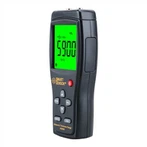
Theoretical principles of infrared thermometry and applications of infrared thermometry
There are many ways to measure temperature. Thermometers can be divided into two categories: contact temperature measurement instruments and non-contact temperature measurement instruments. Contact types include the familiar liquid thermometers, thermocouple thermometers, resistance thermal thermometers, etc. As we all know, temperature is one of the most important parameters in heating, gas supply, ventilation and air conditioning systems. Especially in the thermal measurement process, the accuracy of temperature is often the key to determining the success or failure of the experiment. Therefore, a high-temperature measuring instrument is essential in engineering. Therefore, this article will introduce the principles and applications of infrared thermometers among temperature measurement tools.
The theoretical principle of infrared temperature measurement:
In nature, when the temperature of an object is higher than zero, due to the existence of internal thermal motion, it will continuously radiate electromagnetic waves to the surroundings, including infrared rays with a wavelength range of 0.75µm~100µm. Its characteristic is that at a given temperature and wavelength, the radiant energy emitted by an object has a large value. This material is called a black body, and its reflection coefficient is set to 1. The reflection coefficient of other materials is less than 1, which is called a black body. Gray body, because the relationship between the spectral radiation power P (λT) of the black body and the temperature T satisfies Planck's law. It shows that at the temperature T, the radiant power of the black body per unit area at the wavelength λ is P(λT).
As the temperature increases, the radiant energy of the object becomes stronger. This is the starting point of infrared radiation theory and the basis for the design of single-band infrared thermometers.
As the temperature increases, the radiation peak moves to the shortwave direction (to the left) and satisfies Wien's shift theorem. The wavelength at the peak is inversely proportional to the temperature T, and the dotted line is the line connecting the peaks. This formula tells us why high-temperature thermometers mostly work at short waves, and low-temperature thermometers mostly work at long waves.
The rate of change of radiated energy with temperature is greater at short wavelengths than at long wavelengths. That is, thermometers working at short wavelengths have a relatively high signal-to-noise ratio (high sensitivity) and strong anti-interference. The thermometer should try to work at the peak wavelength. This is particularly important in the case of small low-temperature targets.
Infrared thermometer consists of optical system, photoelectric detector, signal amplifier, signal processing, display output and other parts. The radiation from the measured object and the feedback source is modulated by the modulator and then input to the infrared detector. The difference between the two signals is amplified by the inverse amplifier and controls the temperature of the feedback source so that the spectral radiance of the feedback source is the same as the spectral radiance of the object. The display indicates the brightness temperature of the object being measured