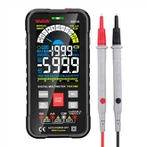
This is how to use a multimeter to measure the power of the heating tube.
The heating tube can be regarded as a purely resistive load, and the current flowing through the heating tube is pure active current. Use a clamp multimeter with an AC current measurement function to measure the current when the heating tube is working. The value obtained by multiplying the current value by the rated voltage of the heating tube is the power (wattage) of the heating tube.
For example, the rated voltage of an electric heating tube is 220 volts, and the measured current is about 2 amps, then the power of this heating tube is about 440 watts. If the rated voltage of the heating tube is 380 volts and the measured current is about 1 A, then the power of the heating tube is about 400 watts.
One thing to pay attention to here is the rated voltage of the heating tube. If a heating tube with a rated voltage of 220 volts is connected to a voltage of 380 volts, the heating wire will be burned out quickly because the voltage is too high. On the contrary, if a heating tube with a rated voltage of 380 volts is connected to a voltage of 220 volts, it will not reach the rated power because it cannot reach the rated voltage.
In actual production, 220-volt and 380-volt electric heating tubes are often used. When ordering electric heating tubes, it is best to let the manufacturer stamp the rated voltage on the heating tube shell with a steel stamp. To avoid confusion.
How to use a multimeter to check circuit lines
The multimeter has a beep stop, which means you use two test leads to test the same wire. If there is a short circuit, there will be no response. If it is a path, there will be a buzzing sound. Sometimes when the device itself has a live case due to poor grounding, you can use the red test lead of the multimeter to place it on the black mark on the case. Rather than directly contacting the ground, the electrical strength of the leakage of the shell can be measured so that the electrical appliance can be informed of the rest of the work. It can also be connected in series to the circuit to measure the AC and DC current.
To check whether the circuit is leaking, you must use a megohmmeter (micrometer), because the voltage of the multimeter is low (9v) and the voltage of the megohmmeter is higher, 500v. Because the line working voltage is 220v, it is difficult to diagnose lines with no obvious leakage. If you want to use a digital meter to check line leakage, you first need to cut off the power supply. After discharging the line, use the resistance level and 2M level to measure. The normal display is 1 (infinity).
To measure whether the circuit is connected, you can use the ohm range of a multimeter to measure it. When measuring, select the meter pointer to deflect 0 ohms. If the line is in the circuit, one end of the line (terminal A) should be connected to the 100 ohm scale of the multimeter (red test lead), and the black test lead should be connected to the other end of the line to be measured (terminal B). If the measured result is zero, it means that this is A connected line is also called a path. Only through a path can current flow through the circuit. If the pointer of the ohm meter of the multimeter from end A to end B of the line is not close to zero ohms, the line is already in an open circuit state. Disconnection is called Break or open circuit.