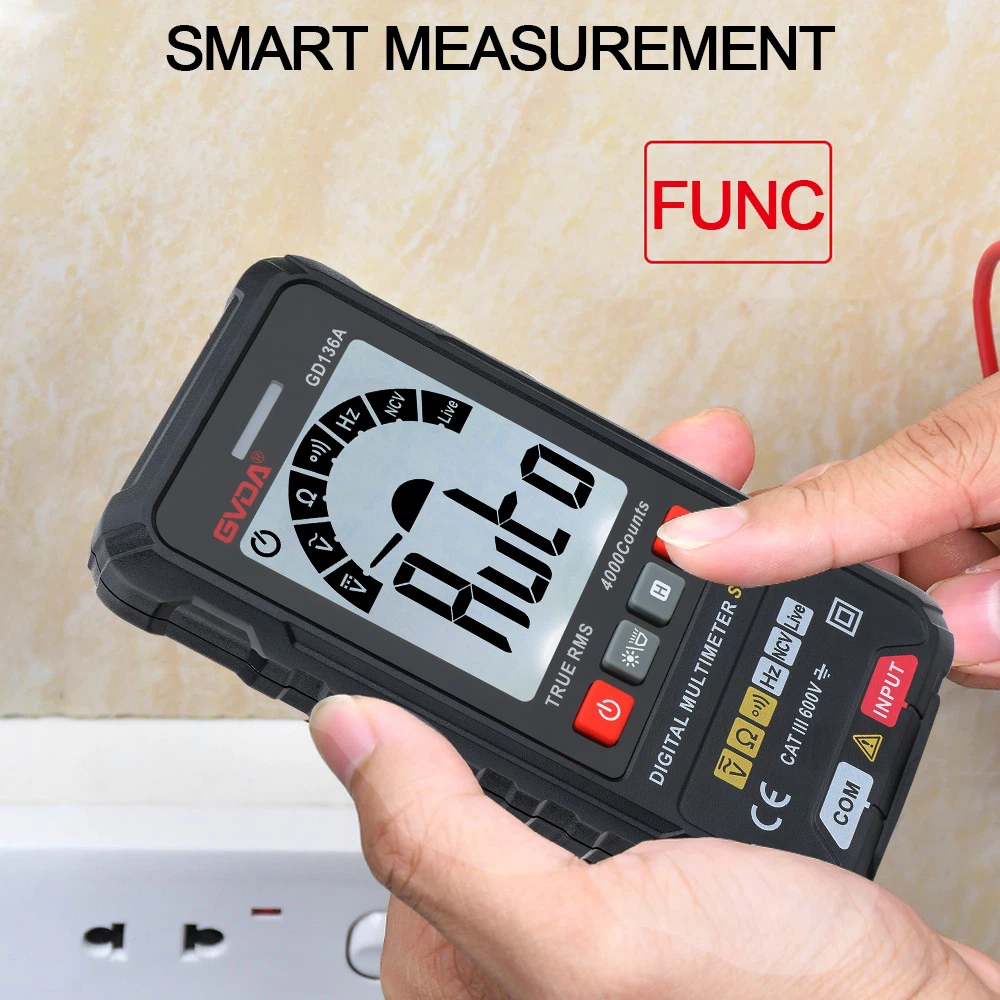
To detect faulty capacitors, a multimeter is usually used to detect
Pointer multimeter detects capacitor failure
1. Fault detection of non-polar capacitors:
When testing, first perform a mechanical zero adjustment on the pointer multimeter. Then select the Rx10k ohm setting of the multimeter, touch the red and black test leads of the meter to the two pins of the capacitor to be measured, and observe the changes in the resistance value indicated by the multimeter.
If the pointer swings slightly to the right and then returns to infinity when the test leads are turned on; if the pointer still swings slightly to the right and then returns to infinity when the test leads are turned on, it means that the capacitor is normal.
If the pointer swings to the right near 0 when the multimeter is turned on, it means that the capacitor has serious leakage or has been broken down.
If the pointer cannot return to infinity after swinging to the right when the multimeter is turned on, it means the capacitor is leaking.
If the pointer does not move when the multimeter is turned on, it means that the capacitor is open circuit.
2. Fault detection of electrolytic capacitors:
Electrolytic capacitors are polarized capacitors. Before testing, use a screwdriver or a flat blade to discharge the remaining charge in the capacitor. Then connect the black test lead of the multimeter to the positive terminal of the capacitor, and the red test lead to the negative terminal, and observe the swing of the meter pointer.
At the moment when it is first connected, the multimeter should deflect a large angle to the right and then return to the left. Until it stops somewhere, the resistance value measured at this time is the forward insulation resistance of the capacitor. The resistance measured after exchanging the test leads is the reverse insulation resistance of the capacitor.
If the pointer of the meter does not move, it means that the capacitor capacity has disappeared or is internally broken.
If the meter detects that both the forward and reverse insulation resistances of the capacitor are very small or 0, it means that the capacitor has large leakage or is internally short-circuited.
Digital multimeter detects capacitor failure
Set the digital multimeter to the capacitance setting and select the appropriate setting according to the amount of electricity. After the capacitor to be measured is fully discharged, directly insert the two pins of the capacitor into the test hole for measurement; or use two test leads to directly contact the capacitor pins for measurement. At this time, the multimeter will directly display the capacity of the measured capacitor.
When measuring an electrolytic capacitor with a digital multimeter, after fully discharging the capacitor to be measured, the red test lead of the meter should be connected to the positive electrode of the capacitor, and the black test lead should be connected to the negative electrode of the capacitor. What is measured at this time is the forward insulation resistance of the capacitor. Vice versa, The measured resistance is the negative insulation resistance.
Capacitor replacement tips:
1. The capacity of the replacement capacitor should be basically the same as the original capacitor.
2. High voltage capacitors can replace low voltage capacitors, but low voltage capacitors cannot replace high voltage capacitors.
3. Small-capacity capacitors connected in parallel can replace large-capacity capacitors; large-capacity capacitors connected in series can replace small-capacity capacitors.
4. Electrolytic capacitors can be used in reverse series to replace non-polar capacitors.
5. High-frequency oscillation capacitors and power supply filter capacitors cannot be replaced by ordinary capacitors.