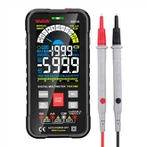
Use a digital multimeter to test the quality of the transistor
Use a diode to measure that one pin is connected to the other two pins, but those two pins are not connected (in the case of a digital meter, if the pin that is common to the other two pins is connected to the red pen, then this is an NPN tube, if the black pen is connected, then this is a PNP tube. If a pointer meter is used, the opposite is true.), this pin is the base set B, and B has been burned out on the other tube. (Those with internal protection diodes are not applicable.)
If the voltage drop measured with the diode gear is greater than 0.5V, it is a silicon tube. If it is around 0.2V, it is a germanium tube.
Then put the measured transistor into the HFE jack according to the pin, and change it to the HFE position to measure the DC amplification factor. (It is only effective for general low-power tubes, but not for high-power tubes. High-power tubes require a large driving power from the base, which a multimeter cannot provide.) The DC amplification factor HFE of general small-power tubes is 30-1000 If the voltage drop measured by one of the pins is several millivolts larger than the other pin, then this pin is the emitter E, and the remaining pin whose voltage drop is several millivolts smaller is the collector C. If you use a diode to measure If any two pins of the tube are open, then the tube has been broken down and damaged. If none of them are connected, then use the diode test method with a digital multimeter. Use a digital multimeter to measure a diode. When it is conducting, it will display a few tenths or a few tenths. When the table is exchanged (that is, when it is cut off), it is displayed as 1. When it displays 1, the black test lead is connected to the anode of the diode, and the red test lead is connected to the cathode of the diode. If it doesn't stop, it must be a bad diode. If the measured result is 1 twice, the measuring diode is open circuit. If the two measured results are a few tenths or both, the diode has broken down.
The comb multimeter has a setting specifically for testing diodes. First, pull the switch to this setting. Connect the red pen to one of the pins, and touch the black pen to the other two pins. If both are connected, it is a PNP type, and the red pen is connected to the other two pins. It is the base. If both of them are unconnected, there are two situations. 1. Turn the test lead and both sides are connected, which means it is NPN. The red pen is connected to the base. 2. Turn the test lead so that one is connected and the other is not connected, that is PNP. , what passes after adjustment is the base.
Connect the red test pen to one pin, and touch the black pen to the other two pins. One is connected and the other is blocked. If you switch it and both are blocked, it is PNP. What the black pen could connect before was the base.
Detect transistors (use "diode gear")
Positive test: The red pen is connected to the positive pole and the black pen is connected to the negative pole to display the forward voltage drop of the PN junction. Normally it should display: silicon tube 0.500~0.700 germanium tube 0.150~0.300
Backtest: The black pen is connected to the positive pole and the red pen is connected to the negative pole. Normally it should display: "1"
Both positive and negative measurements are 0 or 1, indicating that the tube is damaged.
According to the above method of detecting diodes, detect triodes. First determine the collector C and emitter E, and use a meter to measure the forward voltage drop of the two PN junctions. The smaller voltage drop is collector C, and the larger voltage drop is emitter E. The common electrode used for the two measurements is The red pen indicates that this tube is of NPN type. The black pen used for the common pole indicates that this tube is of PNP type.