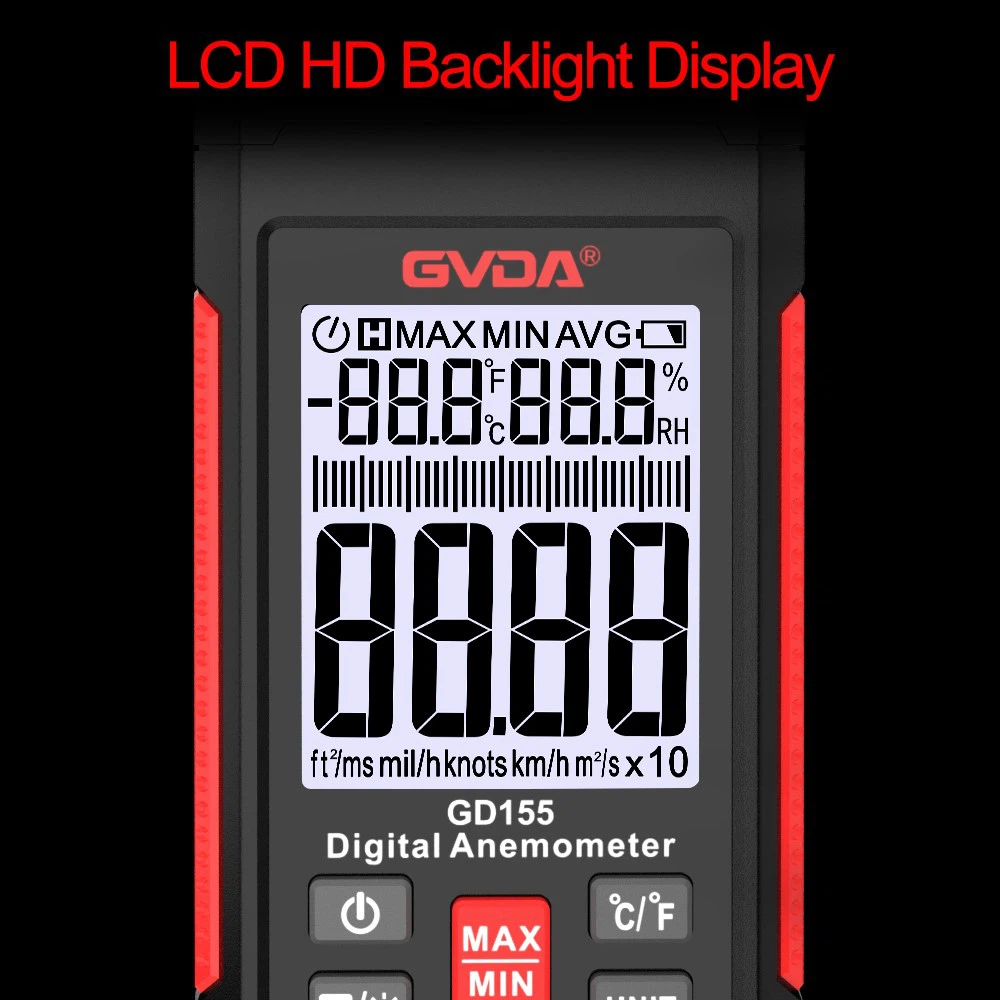
Use an anemometer to measure wind speed and air volume
A, The detection of air volume and wind speed must be carried out first. All purification effects are obtained under the designed air volume and wind speed.
B, Before inspection, check whether the fan is running normally, and it is necessary to measure the size of the tested air outlet and duct on site.
C, For a unidirectional flow (laminar flow) clean room, the air volume is determined by multiplying the average air velocity of the room section by the clean area. (Take a cross-section 0.3m away from the high-efficiency filter and perpendicular to the airflow as the sampling cross-section. Set no less than 5 testing points on the cross-section with a spacing of no more than 0.6m between them. The arithmetic mean of all readings is taken as the average wind speed.) The measurement cross-section of a vertical unidirectional flow (laminar flow) clean room is taken from a horizontal cross-section 0.8m to 1m above the ground; The measurement cross-section of a horizontal unidirectional flow (laminar flow) clean room is taken from a vertical cross-section of 0.5m-1m on the air supply surface; The number of test points on the cross-section should be no less than 10, with a spacing of no more than 2m, and evenly arranged;
D, For air vents with filters installed, the air volume is determined by multiplying the average air velocity at the vent section by the net cross-sectional area of the vent. (Obtain the average wind speed by evenly arranging no less than 6 test points on the section of the air outlet or the section where the auxiliary air duct is referenced.)
E, When there is a long branch pipe section on the windward side of the air outlet and holes have been or can be drilled, the air duct method can be used to determine the air volume. (Drill a hole no less than 3 times the diameter of the pipe or 3 times the length of the larger edge in front of the air outlet;)
F, For rectangular ducts, divide the measured section into several equal small sections, with each small section as close as possible to a square and a side length of no more than 200mm. The test point should be located at the center of the small section, but there should be no less than 3 test points on the entire section; For circular ducts, the cross-sectional area should be determined and the number of test points should be determined using the equal area circular ring method; Drill holes on the outer wall of the air duct and insert a thermal anemometer probe or pitot tube. (Converted to air volume by measuring dynamic pressure.)