Use and maintenance of tool microscope
Construction of Tool Microscope
1. Small tool microscope.
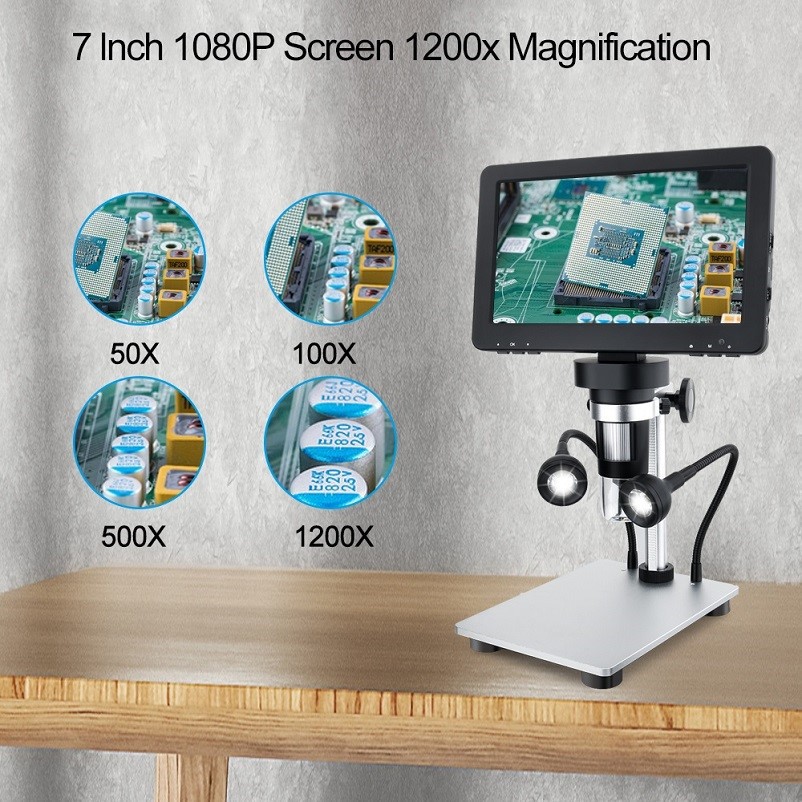
It is composed of a precision cross moving workbench and an observation microscope. It belongs to a small tool microscope and is designed for easy use. Therefore, the pillar will not tilt, and the lighting equipment is also of a simple type. Although it is easy, it can be connected with many accessories to increase various measurement tasks.
2. Large tool microscope.
Its rotary worktable is assembled and also made of a precision cross shaped moving table and observation microscope. The penetrating lighting equipment adopts centrifugal lighting, and the pillar and worktable can be integrated to tilt left and right, making thread measurement very convenient. The eye observation section is equipped with a projection device, which can be used for observing projected images.
Measurement of tool microscope
1. Cartesian coordinate measurement:
When measuring, it is necessary to ensure that the direction of the right angle coordinate of the measured object is consistent with the direction of movement of the cross shaped workbench before conducting the measurement. When using Cartesian coordinate measurement, the movement amount of the cross moving workbench can directly read the Cartesian coordinate value. If it is a large tool microscope, the image on the aiming hole Cartesian coordinate measurement can be connected to the observation eye for accurate measurement. However, when calibrating the direction of the measured object's Cartesian coordinate and the cross moving workbench, it is very convenient to use an assembled rotating workbench installed on a large tool microscope, As for small tool microscopes, they only need a rotating table attachment.
2. Angle measurement:
Measurements can be made using a rotating workbench or angle observation lens. Generally speaking, the accuracy of angle observation lenses is better.
3. Height measurement:
Although a small tool microscope cannot measure height, if the measuring silver is installed on the upper end of the pillar and the microscope's up and down movement is used, the height can be measured. However, due to factors such as focal depth, pillar inclination, and errors between the measurement of silver and the optical axis, it is quite difficult to accurately measure.
4. Pore size measurement:
Generally, angle observation lenses are used for measurement, but large tool microscopes can use overlapping image observation lenses or optical detectors. This means using overlapping image lenses to overlap the two generated images, and then on the opposite side, the inner diameter of the hole can be displayed by the amount of movement. If using an optical detector, first install it on a 3x object lens, then align it with the direction of movement of the detector and the workbench, and then adjust the overlap line inside the observation lens to be parallel to the cross line of the observation lens, so that the measuring stator contacts the hole surface. Finally, use the feed on the Y-axis to correct the reverse movement of the overlap line, and use the X-axis feed to clamp the overlap line onto the ten sub lines of the observation lens to read the measured values on the X-axis. The opposite side of the hole is also the same, so adding the difference in reading and the diameter of the probe can obtain the inner diameter of the hole.