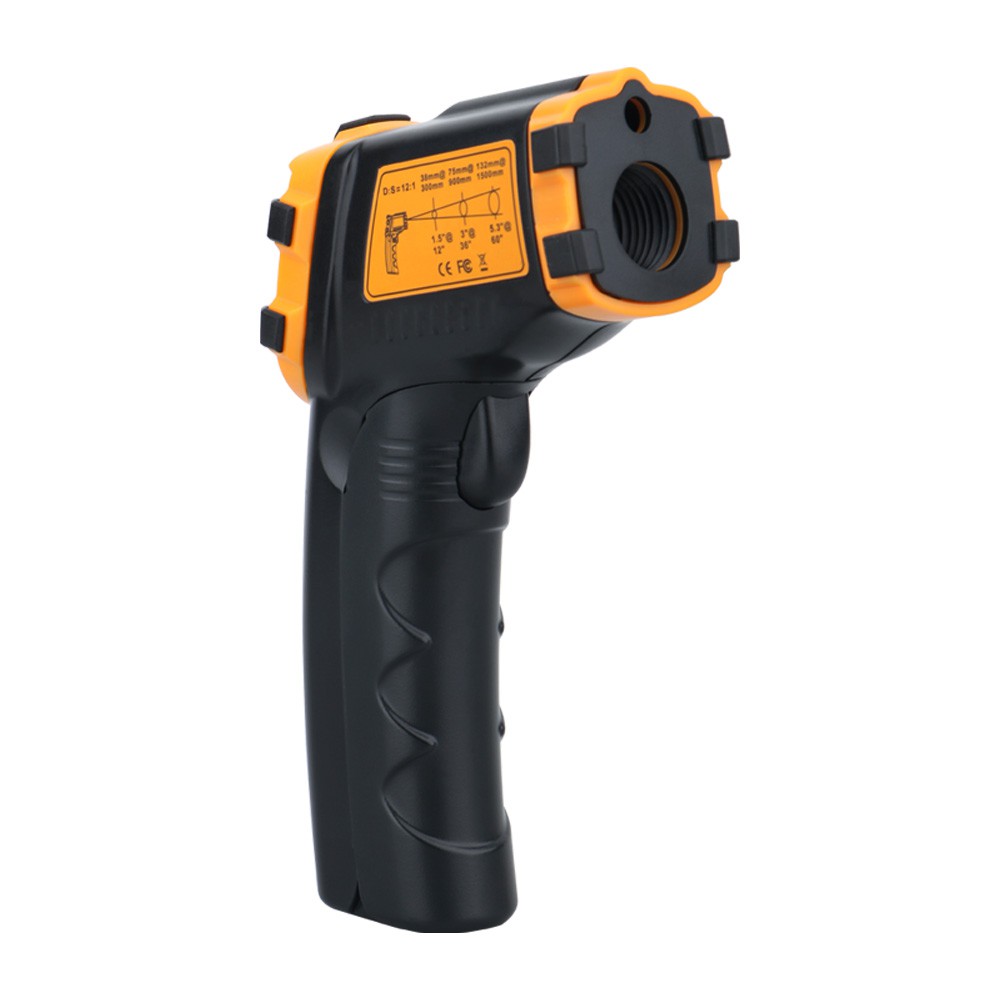
What are the 7 major applications of infrared thermometers
Professional maintenance technicians have come to find that when temperature is a clear indication of performance or critical condition, Fluke contact thermometers can help them find and solve problems faster and more efficiently. Fluke infrared thermometer has many advantages such as fast, convenient to carry, accurate and easy to use: just align and pull the trigger to read the temperature value of the measured target.
Here are three basic applications where infrared thermometers help users troubleshoot:
1. Spot measurement to determine the "absolute" temperature of the surface of the measured object.
2. Temperature difference measurement, comparing the temperature of two or more locations or the temperature at different times.
3. Temperature scanning to determine parameters that can explain the fault state, such as relative temperature, hot or cold spots, and temperature changes.
Tips: Ordinary infrared thermometers cannot measure temperature through glass, and the reading is the surface temperature of the glass.
Accurate measurements can be difficult on polished metals and reflective surfaces. If possible, you can use quick-drying paint to coat the surface of the measured object; for high-temperature measured objects, you can use hot "engine porcelain reading", you can also use ordinary tape, or use spray lubricants (such as WD40) Spray the surface. These surface treatment techniques can enhance the surface under test to obtain accurate readings.
Industrial device
Since the infrared thermometer uses a non-contact measurement method, the safety factor when measuring in hazardous areas is improved. With Fluke non-contact infrared thermometers, it's easy to get instant temperatures on very hot surfaces, hard-to-reach locations, live electrical panels and equipment, and in and around mobile equipment machinery.
1. Electrical maintenance, check for heat build-up due to loose connections, collectively diagnose battery pack and switchboard terminal blocks, ballasts, switchgear and fuse connection failures; identify hot spots of output filters on DC battery lines.
2. Equipment maintenance, measure the rotating parts and casings in the motor and gearbox, and check whether there are hot spots. Changes in temperature can indicate the development of faults in everything from bins to coolers. Regularly checking the temperature of the generator and its bearings can prevent costly repairs.
3. For electric motors, a rise in motor temperature may be a sign of overload, damaged windings, bearing failure, or voltage imbalance. The Fokker thermometer can be used to regularly check the operating temperature of motors, generators and bearings without stopping the equipment. The measurement results of new equipment and normal equipment can be archived as the measurement benchmark. Performance faults can be easily identified by comparing future measurements to baseline data.
4. Circuit breakers, through non-contact temperature scanning, can identify overloaded circuits or poor connections. Wearing appropriate protective gear, the user can scan switchgear and check temperature readings breaker by breaker. If a circuit breaker is hot, it may indicate a fault. Then use the Fluke type meter to carry out a detailed inspection.
5. Air-conditioning HVAC system, easy and efficient diagnosis of boiler and circulation faults, cooling and refrigeration systems, heat exchangers, air ducts and distribution systems. Scan the compressor and condenser for overheating or blocked air ducts.
6. In the steam system, the surface temperature of the steam trap can be read with a Fluke non-contact thermometer to determine whether the door has a switch failure. There should be a noticeable drop in temperature when measured from input to output. If the temperature does not drop, the valve is not open; but if the drop is too large, the door is completely closed. By monitoring the valve, faults can be more easily diagnosed.
7. Insulation test, measure the insulation of pipes and boilers to check for hot spots. Scan with a Fluke Infrared Thermometer, check the maximum temperature reading after the scan is complete, the maximum temperature can be 204°C, and the non-insulated area will be higher.