What are the five main sources of output ripple in switching power supplies?
The output ripple of switching power supply mainly comes from five aspects: input low-frequency ripple; High frequency ripple; Common mode ripple noise caused by parasitic parameters; The ultra-high frequency resonant noise generated during the switching process of power devices; Ripple noise caused by closed-loop regulation control.
Ripples are AC interference signals superimposed on DC signals and are an important standard in power testing. Especially for power supplies used for special purposes, such as laser power supplies, ripple is one of their fatal factors. Therefore, the testing of power ripple is extremely important.
There are roughly two methods for measuring power ripple: one is voltage signal measurement; The other clock is the current signal measurement method.
Generally, voltage signal measurement method can be used for constant voltage sources or constant current sources with low ripple performance requirements. For constant current sources with high ripple performance requirements, it is best to use the current signal measurement method.
Voltage signal measurement ripple refers to the use of an oscilloscope to measure the AC ripple voltage signal superimposed on the DC voltage signal. For constant voltage sources, testing can directly measure the voltage signal output to the load using a voltage probe. For the testing of a constant current source, it is generally done by using a voltage probe to measure the voltage waveform at both ends of the sampling resistor. During the entire testing process, the setting of the oscilloscope is the key to whether the real signal can be sampled.
1. Channel settings:
Coupling: refers to the selection of channel coupling methods. Ripple is an AC signal superimposed on a DC signal, so when we want to test the ripple signal, we can remove the DC signal and directly measure the superimposed AC signal.
Broadband restriction: off
Probe: First, select a voltage probe. Then select the attenuation ratio of the probe. The attenuation ratio must be consistent with the actual probe used, so that the number read from the oscilloscope is the true data. For example, the voltage probe used is placed on the × At this point, the option for the probe here must also be set to × 10th gear.
2. Trigger settings:
Type: Edge
Source: The actual selected channel, such as preparing to test with CH1 channel, should be selected as CH1 here.
Slope: Rising.
Trigger method: If observing the ripple signal in real-time, select 'automatic' trigger. The oscilloscope will automatically follow the changes in the actual measured signal and display it. At this time, you can also set the measurement button to display the required measurement values in real time. However, if you want to capture the signal waveform during a measurement, you need to set the trigger method to 'normal' trigger. At this point, it is also necessary to set the trigger level. Generally, when you know the peak value of the signal you are measuring, set the trigger level to 1/3 of the peak value of the measured signal. If not known, the trigger level can be set slightly lower.
Coupling: DC or AC, usually using AC coupling.
3. Sampling length (seconds/grid):
The setting of sampling length determines whether the required data can be sampled. When the set sampling length is too large, it will miss out on the high-frequency components in the actual signal; When the sampling length set is too small, only local parts of the measured actual signal can be seen, and the true actual signal cannot be obtained. So, in actual measurement, it is necessary to rotate the button back and forth and observe carefully until the displayed waveform is a true and complete waveform.
4. Sampling method:
It can be set according to actual needs. If it is required to measure the P-P value of the ripple, it is best to choose the peak measurement method. The sampling frequency can also be set according to actual needs, which is related to the sampling frequency and sampling length.
5. Measurement:
By selecting the peak measurement of the corresponding channel, the oscilloscope can help you display the required data in a timely manner. At the same time, you can also choose the frequency, maximum value, root mean square value, etc. of the corresponding channel.
By setting up the oscilloscope reasonably and operating it in a standardized manner, the required ripple signal can definitely be obtained. However, during the measurement process, it is necessary to pay attention to preventing interference from other signals on the oscilloscope probe itself, in order to avoid the measured signal being not true enough.
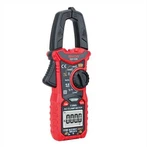
Measuring ripple value through current signal measurement method refers to measuring the AC ripple current signal superimposed on the DC current signal. For constant current sources with high ripple requirements, i.e. those with small ripple requirements, the direct measurement method of current signals can obtain more realistic ripple signals. Unlike the voltage measurement method, a current probe is also used here. For example, continue using the oscilloscope mentioned above, and add a current amplifier and a current probe. At this point, simply clamp the current signal output to the load with a current probe, and the current measurement method can be used to measure the ripple signal of the output current. Like the voltage measurement method, the setting of the oscilloscope and current amplifier is the key to whether the real signal can be sampled during the entire testing process