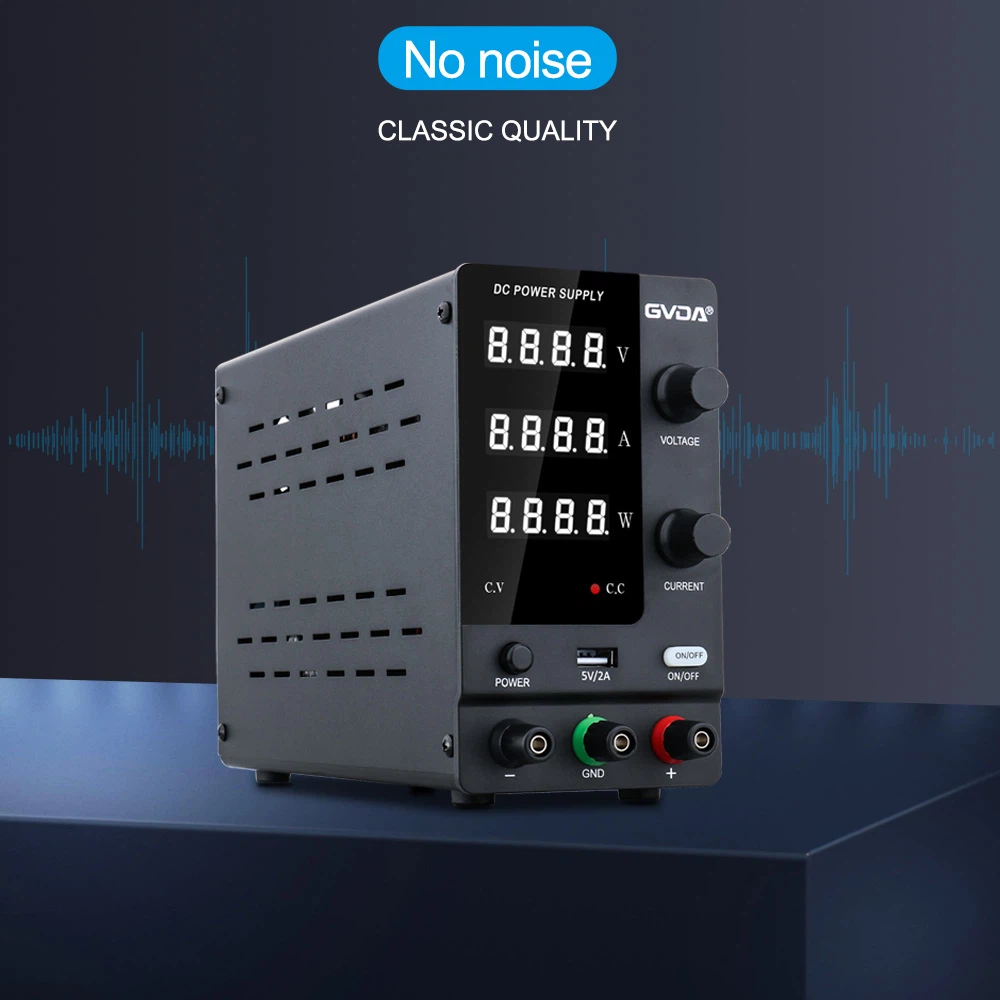
Analysis of Several Control Methods for Singlechip Controlled Switching Power Supply
There are several control methods for controlling the power output of a single-chip microcomputer controlled switching power supply.
One is that the microcontroller outputs a voltage (via DA chip or PWM mode), which is used as the reference voltage for the power supply. This method only replaces the original reference voltage with a microcontroller, which can input the output voltage value of the power supply with a button. The microcontroller does not add a feedback loop of the power supply, and there are no changes to the power circuit. This method is the simplest.
The second is to expand the AD of the microcontroller, continuously detecting the output voltage of the power supply, adjusting the output of the DA based on the difference between the output voltage of the power supply and the set value, controlling the PWM chip, and indirectly controlling the operation of the power supply. In this way, the microcontroller has been added to the feedback loop of the power supply, replacing the original amplification link. The microcontroller program needs to use a more complex PID algorithm.
The third is to expand the AD of the microcontroller, continuously detecting the output voltage of the power supply, and outputting PWM waves based on the difference between the output voltage of the power supply and the set value, directly controlling the operation of the power supply. This way, the microcontroller is most involved in power supply operation.
The third method is the most thorough single-chip microcomputer control switch power supply, but the requirements for single-chip microcontrollers are also the highest. The microcontroller is required to have fast computing speed and be able to output PWM waves of sufficiently high frequency. Such microcontrollers are obviously expensive.
The speed of DSP based microcontrollers is high enough, but the current price is also very high. From a cost perspective, the proportion of power cost is too large to be adopted.
Among low-cost microcontrollers, the AVR series is the fastest and has PWM output, which can be considered for adoption. However, the working frequency of the AVR microcontroller is still not high enough and can only be used reluctantly. Below, we will calculate the level to which the AVR microcontroller can directly control the operation of the switching power supply.
In the AVR microcontroller, the maximum clock frequency is 16MHz. If the PWM resolution is 10 bits, then the frequency of the PWM wave, also known as the operating frequency of the switching power supply, is 16000000/1024=15625 (Hz). It is obviously not enough for the switching power supply to operate at this frequency (within the audio range). So, taking the PWM resolution as 9 bits, the working frequency of the switching power supply this time is 16000000/512=32768 (Hz), which can be used outside the audio range, but there is still a certain distance from the working frequency of modern switching power supplies.
However, it must be noted that the 9-bit resolution means that during the power transistor on off cycle, it can be divided into 512 parts. In terms of conduction alone, assuming a duty cycle of 0.5, it can only be divided into 256 parts. Considering that the pulse width is not linearly related to the output of the power supply, it is necessary to make at least one more fold. In other words, the power output can only be controlled to 1/128 at most, regardless of load changes or grid voltage changes, the degree of control can only reach this point.