What are the main applications of anemometers?
An anemometer is an instrument that measures the speed of air flow. There are many types of it, and the most commonly used one at meteorological stations is the wind cup anemometer;
It consists of three parabolic cone empty cups fixed on the bracket at 120° to each other to form the sensing part. The concave surfaces of the empty cups are all oriented in one direction.
The entire sensing part is installed on a vertical rotating axis. Under the action of wind force, the wind cup rotates around the axis at a speed proportional to the wind speed.
Another type of rotating anemometer is the propeller anemometer, which consists of a three- or four-blade propeller as the sensing part;
Install it on the front of a weathervane so that it points in the direction of the wind at all times. The blades rotate around a horizontal axis at a speed proportional to the wind speed.
Anemometers have a wide range of applications and can be used flexibly in all fields. They are widely used in electric power, steel, petrochemical, energy conservation and other industries;
There are other applications in the Beijing Olympic Games. Sailing competitions, rowing competitions, field shooting competitions, etc. all require the use of anemometers for measurement.
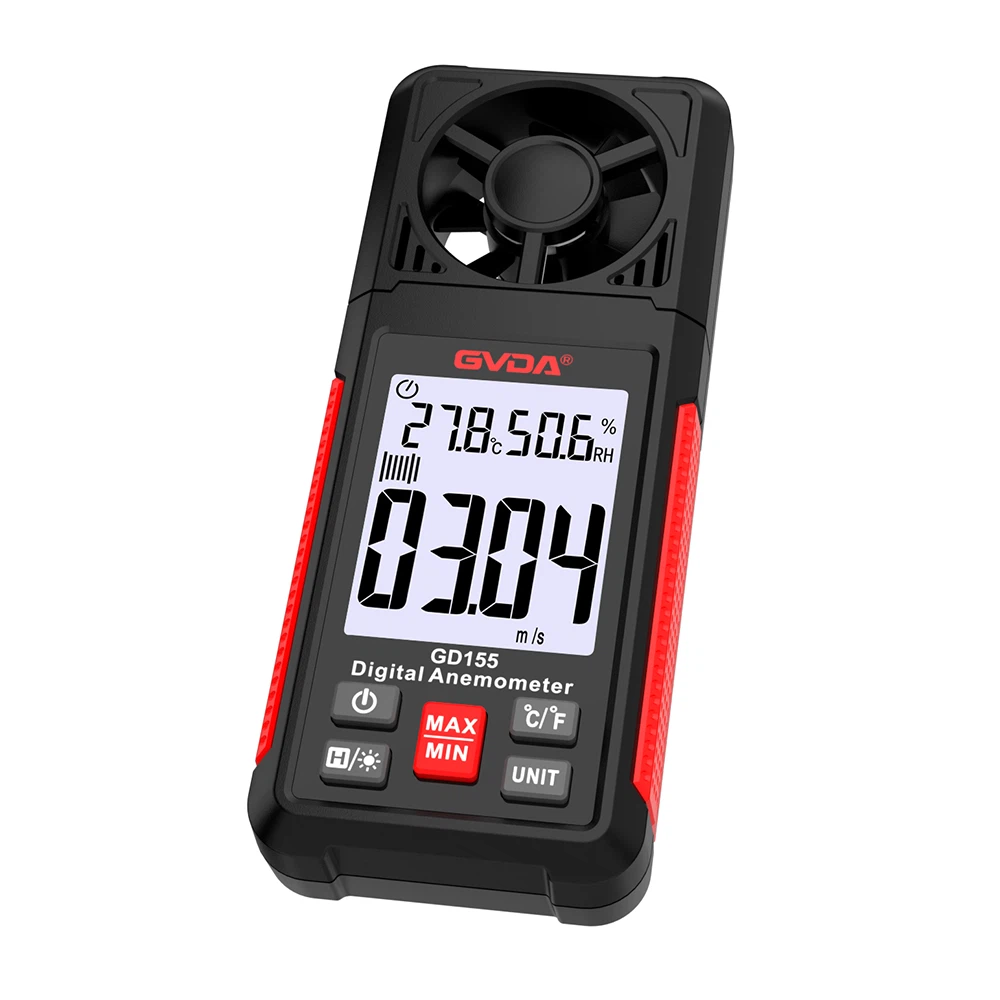
Today's anemometers are relatively advanced. In addition to measuring wind speed, they can also measure wind temperature and air volume.
There are many industries that need to use anemometers. Recommended industries include: fishing industry, various fan manufacturing industries, industries that require ventilation and exhaust systems, etc.
Main uses of anemometer:
1. Measure the speed and direction of average flow.
2. Measure the pulsation speed and spectrum of the incoming flow.
3. Measure the Reynolds stress in turbulent flow and the velocity correlation and time correlation between two points.
4. Measure wall shear stress (usually done by using a hot film probe placed flush with the wall, the principle is similar to dedicated line speed measurement).
5. Measure the fluid temperature (measure the change curve of the probe resistance with the fluid temperature in advance, and then determine the temperature based on the measured probe resistance.