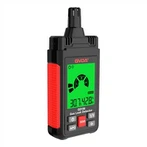
What Are the Precautions for Measuring Resistance Using a Multimeter?
A multimeter is a commonly used electronic measuring instrument used to measure basic electrical parameters such as voltage, current, and resistance. When measuring resistance with a multimeter, some precautions and correct methods are also needed to obtain accurate results. The following will introduce the precautions and reading methods for measuring resistance with a multimeter.
Notes:
Firstly, ensure that the tested circuit is in a power-off state to avoid short circuits and excessive current during the measurement process, in order to ensure safety.
When measuring with a suitable resistance range, the resistance range of a multimeter is generally 200 ohms, 2 kiloohms, 20 kiloohms, 200 kiloohms, etc. Choosing the appropriate range can make the measurement results more accurate, and careful operation should be carried out when switching ranges to avoid damaging the probes or causing other errors.
To eliminate other charges generated by the tested circuit and avoid the influence of voltage interference or resonance phenomena, a resistor wrapped around the finger can be used to short-circuit the circuit, transfer the charges to oneself, and then proceed with the measurement.
The contact point of the multimeter's probe with the circuit should be firm to ensure the stability of the measured resistance. You can gently twist the probe to ensure good contact.
When necessary, special treatment should be applied to the tested circuit, such as discharging capacitors, disconnecting metal components, etc., to eliminate measurement errors.
Reading method:
Start the multimeter, select the resistance measurement gear, and refer to the precautions mentioned earlier to choose the appropriate gear.
Connect the red and black probes to the two ends of the tested resistor respectively, ensuring that there is no other resistance between the probe and the tested resistor that affects the measurement accuracy.
Wait for a period of time until the reading stabilizes, in order to obtain relatively accurate measurement results. If the probe touches a thermoelectric sensitive element or measures resistance near a strong magnetic field, it will take a longer time to ensure that the effects of thermoelectric potential and magnetic field are eliminated.
Pay attention to the precise position of the reading, and use the position closest to the indicated value as the measurement result. Usually, a multimeter has an indicator arrow pointing to the reading value. Sometimes, the reading may have a decimal point indicating the number of decimal places.
To improve measurement accuracy, the resistance can be measured multiple times and the readings can be averaged.
By following the above precautions and reading methods, we can correctly use a multimeter to measure resistance and obtain relatively accurate results. Of course, for some special occasions and special resistors, there may be other special requirements and usage methods that need to be operated according to specific circumstances.