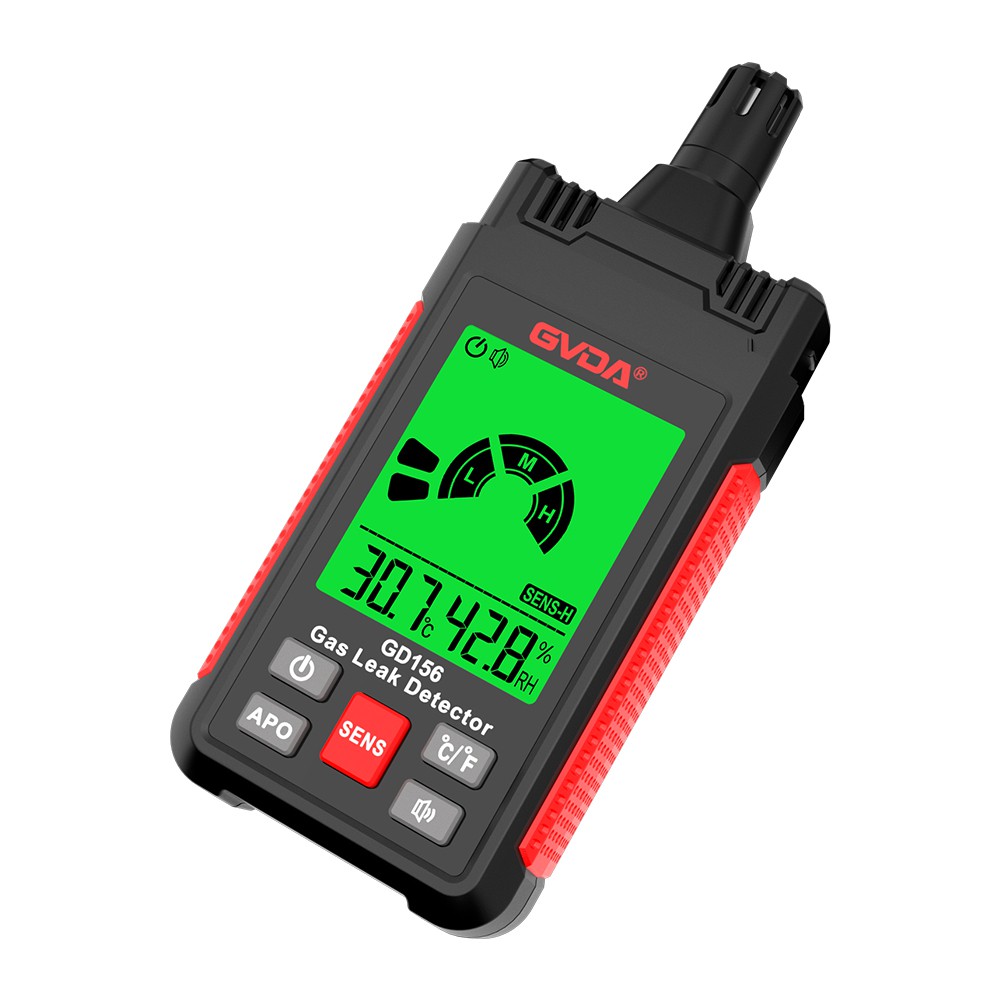
What are the sensors commonly used in gas detectors?
The most essential part of a gas detector is the gas sensor, which varies according to different gas detection principles. Common gas sensors include PID photoionization sensors, infrared sensors, electrochemical sensors, catalytic combustion sensors, and semiconductor sensors. Below, Honieger Technology will provide you with a detailed introduction to the working principles, advantages, and disadvantages of each sensor.
1, Infrared principle of gas detector
Principle: Non dispersive infrared (NDIR) sensor utilizes the Beer Lambert infrared absorption law, which states that different gases absorb light of specific wavelengths, and the intensity of absorption is proportional to the concentration of the gas to achieve detection. It is the application of a filter to divide infrared light into the required spectral lines in a very small band, and the detected gas absorbs these spectral lines in this very small band.
Advantages: High reliability, good selectivity, high accuracy, no toxicity, less environmental interference, long lifespan, and no dependence on oxygen.
Disadvantages: It is greatly affected by humidity and has limited detection of gas types. Currently, it is mainly used for gases such as methane, carbon dioxide, carbon monoxide, sulfur hexafluoride, sulfur dioxide, and hydrocarbons.
2, Semiconductor principle of gas detector
Principle: Semiconductor gas sensors are manufactured based on the principle that the resistance of some metal oxide semiconductor materials changes with the composition of the ambient gas at a certain temperature. For example, an alcohol sensor is prepared based on the principle that the resistance of tin dioxide decreases sharply when it encounters alcohol gas at high temperatures.
Advantages: It has the advantages of low cost, simple manufacturing, high sensitivity, fast response speed, long lifespan, low sensitivity to humidity, and simple circuit.
Disadvantages: Poor stability, greatly affected by the environment, especially the selectivity of each sensor is not unique, and the output parameters cannot be determined. Therefore, it is not suitable for places that require accurate measurement and is mainly used for civilian purposes.
3, Catalytic combustion principle of gas detector
Principle: Catalytic combustion sensor is a high-temperature resistant catalyst layer prepared on the surface of a platinum resistor. At a certain temperature, combustible gases catalyze combustion on its surface, causing the temperature of the platinum resistor to increase and the resistance to change. The change value is a function of the concentration of combustible gases.
Advantages: Catalytic combustion gas sensors selectively detect flammable gases: the sensor has no response to anything that cannot be burned. Fast response, long lifespan, and less affected by temperature, humidity, and pressure. The output of sensors is directly related to the explosion hazard of the environment and is a dominant type of sensor in the field of safety detection.
Disadvantage: No selectivity within the flammable gas range. Sensors are prone to poisoning, and most organic vapors have a toxic effect on sensors.
Note: The feasibility of catalytic combustion detection is conditional, and it is necessary to ensure that the detection environment contains sufficient oxygen. In an oxygen free environment, this detection method may not be able to detect any flammable gases. Certain lead containing compounds (especially tetraethyl lead), sulfur compounds, silicones, phosphorus compounds, hydrogen sulfide, and halogenated hydrocarbons may cause sensor poisoning or inhibition.