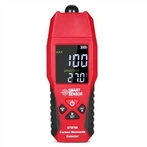
The gas detector can assist our team in determining whether the amount of combustible and poisonous gas in the workplace exceeds the recommended threshold. It may also identify equipment or pipeline leaks that may be releasing combustible and toxic gas, with concentrations that may even be as low as PPM. The editor of Honeyegger Technology will describe the gas detector detection standards and how to select a gas detector below.
1. Inspection of appearance and functionality
1) Scan for appearance and additional stuff
The first thing we do after getting a gas detector is to check its appearance. This is done to prevent minor issues during the gas detector's production and assembly processes as well as during shipping. We must determine whether the gas detector's appearance is defective, fractured, or damaged, as well as whether the structure of all of its components is complete.
In order to assure accuracy, verify the gas detector body's machine model, label, manufacturer's name, and factory time against the guidelines or data provided by the manufacturer. Check the gas detector's explosion-proof mark and measurement license concurrently. The logo and serial number must contain all necessary information, and the producer may supply some certificates.
2). Power-on inspection
The power supply, which is typically powered by the built-in battery, is necessary for the gas detector to function. To see if the gas detector is powered on normally, we must flip the switch. He can keep working with some gas detectors by changing the battery. A charger is included with the detector. We must check the charger's charge in order to use the gas detector equipped with one. We must verify that the gas detector's display screen is functioning normally when the electricity is normal.
3). Check whether the sound and light alarm of the instrument is normal
For the gas detector with sound and light alarm signal, because it is powered by battery, when the undervoltage is displayed, it should be able to send out sound or light indicating signal which is obviously different from the alarm signal.
2. Indication error
The gas detector we purchased is used to detect gas concentration. The gas detector cannot be very accurate in displaying gas concentration. It has errors, but this error has a range. If it exceeds this range, then It means that this gas detector is not in compliance with the standard, and its specified indication error is different for different gases. For example, it is normal for the indication error of oxygen to be within ±0.5%VOL.
3. Alarm error
We mentioned the error of the displayed value above, so there is a certain allowable error for the alarm value of the gas detector, because the instrument will be affected by various factors, and it is impossible to alarm at an accurate concentration every time. Therefore, the concentration of the alarm is allowed to have errors, as long as the error is within the standard range. For different gases, its alarm error is also different, for example, the alarm error of oxygen is within ±0.1%VOL.
4. Response time
The response time refers to the time it takes for the gas detector's indication value to rise from zero to 90% of the stable indication value that the instrument should reach. This time also has standard requirements. This standard is the same as the indication error and the alarm error. Different gases have different response times. For example, the response time for oxygen is less than or equal to 20S.
5. Insulation withstand voltage
For gas detectors, there are also some insulation withstand voltage standards that must be met. Standard requirements: normal temperature: ≥100MΩ; after damp heat: ≥1MΩ. The dielectric strength should be able to withstand 500V AC voltage for 1min, and there should be no discharge and breakdown phenomena. Only after these are met will the gas detector meet the standard.