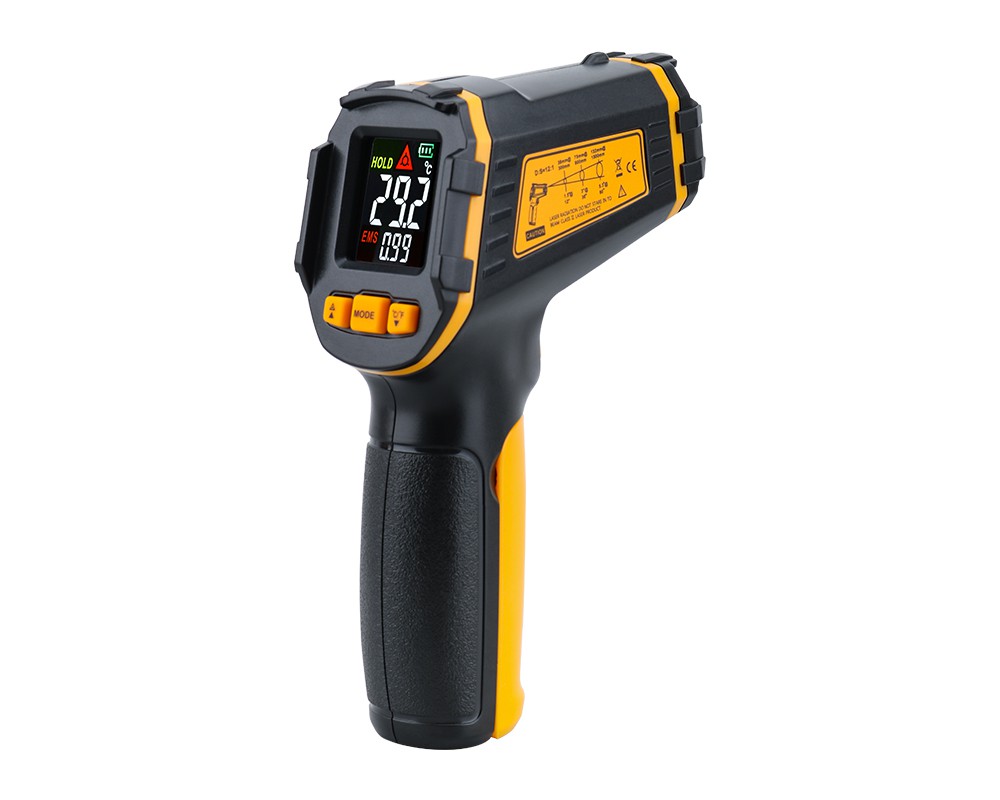
What do you know about the factors for purchasing an infrared thermometer?
1. Determine the temperature measurement range
Determine the temperature measurement range: The temperature measurement range is the most important performance index of the thermometer. Each type of thermometer has its own specific temperature range. For example, Raytek (Raytek) products cover a range of -50°C-+3000°C, but this cannot be done by one type of infrared thermometer. Therefore, the user's measured temperature range must be considered accurately and comprehensively, neither too narrow nor too wide.
According to the law of blackbody radiation, the change of radiation energy caused by temperature in the short-wave band of the spectrum will exceed the change of radiation energy caused by emissivity error. Therefore, it is better to use short-wave as much as possible when measuring temperature. Generally speaking, the narrower the temperature measurement range is, the higher the resolution of the output signal of the temperature monitoring is, and the accuracy and reliability are easy to solve. If the temperature measurement range is too wide, the temperature measurement accuracy will be reduced. For example, if the measured target temperature is 1000 degrees Celsius, first determine whether it is online or portable, and if it is portable.
There are many models that meet this temperature, such as 3iLR3, 3i2M, 3i1M. If the measurement accuracy is the main thing, it is better to choose the 2M or 1M type, because if the 3iLR type is used, the temperature measurement range is very wide, and the high temperature measurement performance will be poor; For low temperature targets, we have to choose 3iLR3.
2. Determine the target size
In order to obtain jingque temperature readings, the distance between the thermometer and the test target must be within an appropriate range. The so-called "spot size" is the area of the measuring point of the thermometer. The farther you are from the target, the larger the spot size.
Infrared thermometers can be divided into single-color thermometers and two-color thermometers (radiation colorimetric thermometers) according to the principle. For a monochromatic thermometer, when measuring temperature, the area of the target to be measured should fill the field of view of the thermometer. It is recommended that the measured target size exceed 50% of the field of view. If the target size is smaller than the field of view, the background radiation energy will enter the visual and acoustic symbols of the thermometer and interfere with the temperature measurement readings, causing errors.
Conversely, if the target is larger than the pyrometer's field of view, the pyrometer will not be affected by background outside the measurement area. For colorimetric thermometers, the temperature is determined by the ratio of radiant energy in two independent wavelength bands. Therefore, when the target to be measured is small, does not fill the field of view, and there is smoke, dust, or obstruction on the measurement path that attenuates the radiation energy, it will not affect the measurement results. Even in the case of 95% energy attenuation, the required temperature measurement accuracy can still be guaranteed.
For small and moving or vibrating targets, the colorimetric thermometer is the best choice. This is due to the light's small diameter, flexibility, and ability to transmit optical radiant energy over curved, blocked, and folded channels, thus enabling measurement of targets that are inaccessible, in harsh conditions, or close to electromagnetic fields.
3. Determine the distance factor (optical resolution)
The distance coefficient is determined by the ratio of D:S, that is, the ratio of the distance D between the probe of the thermometer to the target and the diameter of the target to be measured. The higher the optical resolution, i.e. increasing the D:S ratio, the higher the cost of the pyrometer. If the thermometer must be installed far away from the target due to environmental conditions, and a small target must be measured, a thermometer with high optical resolution should be selected.
For a pyrometer with a fixed focal length, the focal point of the optical system is the smallest position of the spot, and the spot near and far from the focal point will increase. There are two distance factors. Therefore, in order to measure temperature accurately at a distance close to and far from the focus, the size of the target to be measured should be larger than the spot size at the focus. The zoom thermometer has a minimum focus position, which can be adjusted according to the distance to the target. If D:S is increased, the received energy will decrease. If the receiving aperture is not increased, the distance coefficient D:S will be difficult to increase, which will increase the cost of the instrument.
4. Determine the wavelength range
The emissivity and surface properties of the target material determine the spectral response wavelength of the pyrometer. For high reflectivity alloy materials, there is low or varying emissivity. In the high temperature area, the best wavelength for measuring metal materials is near infrared, and 0.8-1.0μm can be selected. Other temperature zones can choose 1.6μm, 2.2μm and 3.9μm. Since some materials are transparent at a certain wavelength, infrared energy will penetrate these materials, and a special wavelength should be selected for this material.
For example, 1.0μm, 2.2μm and 3.9μm are used to measure the internal temperature of the glass (the glass to be tested must be very thick, otherwise it will pass through) wavelengths; 5.0μm is used to measure the surface temperature of the glass; For example, 3.43μm is used for measuring polyethylene plastic film, 4.3μm or 7.9μm is used for polyester, and 8-14μm is used for thickness exceeding 0.4mm. For example, the narrow band 4.64μm is used to measure CO in the flame, and 4.47μm is used to measure NO2 in the flame.
5. Determine response time
Response time is defined as the time required to reach 95% of the energy of the final reading, indicating the reaction speed of the infrared thermometer to the measured temperature change, which is related to the time constant of the photodetector, signal processing circuit and display system. The choice of the response time of the infrared thermometer should be adapted to the situation of the measured target, and the determination of the response time is mainly based on the target's movement speed and the target's temperature change speed.
If the moving speed of the target is very fast or when measuring a fast-heating target, a fast-response infrared thermometer should be selected, otherwise the sufficient signal response will not be achieved, and the measurement accuracy will be reduced. However, not all applications require a fast-response infrared thermometer. For static or target thermal processes where thermal inertia exists, the response time requirement can be relaxed.
6. Signal processing function
In view of the difference between the discrete process (such as part quality) and the continuous process, the infrared thermometer is required to have multi-signal processing functions (such as peak hold, valley hold, average value) to choose from, such as when measuring the temperature of the bottle on the conveyor belt, It is necessary to use peak hold, and the output signal of its temperature is sent to the controller. Otherwise the thermometer reads a lower temperature value between the bottles. If using peak hold, set the thermometer response time to be slightly longer than the time interval between bottles so that at least one bottle is always under measurement.
7. Consideration of environmental conditions
The environmental conditions of the thermometer have a great influence on the measurement results, which should be considered and properly resolved, otherwise it will affect the temperature measurement accuracy and even cause damage. When the ambient temperature is high and there is dust, smoke and steam, the protective cover, water cooling, air cooling system, air purger and other accessories provided by the manufacturer can be selected. These accessories can effectively address environmental influences and protect the thermometer for accurate temperature measurement.
When specifying accessories, standardize service should be requested as much as possible to reduce installation costs. When smoke, dust or other particles reduce the measurement energy signal under noise, electromagnetic field, vibration or inaccessible environmental conditions, or other harsh conditions, the fiber optic two-color thermometer is the best choice. In noise, electromagnetic field, vibration and inaccessible environmental conditions, or other harsh conditions, it is advisable to choose a light colorimetric thermometer.